Claude Prompts for Content Creation: What Actually Works After Two Years of Daily Use
Claude Prompts for Content Creation: What Actually Works After Two Years of Daily Use
I’ve been creating content with Claude since mid-2024, back when most of us were still figuring out whether AI writing tools would actually deliver on their promise or just churn out generic garbage that sounded like it was written by a committee of robots. The answer, it turned out, depends almost entirely on how you talk to it.
After creating hundreds of articles, blog posts, social media campaigns, and marketing copy using Claude, I’ve learned that the prompt makes or breaks everything. A lazy prompt gets you forgettable content that reads like every other AI-generated piece flooding the internet. A well-crafted prompt gets you something actually useful—a strong draft that you can shape into something genuinely valuable.
This guide shares the specific prompts and strategies that have consistently worked for me and the content teams I’ve worked with. These aren’t theoretical—they’re battle-tested approaches from real content projects with real deadlines and real audiences.
Why Claude Specifically for Content Creation?
Before diving into prompts, let me explain why I gravitated toward Claude over other AI writing tools.
I started with ChatGPT like most people, and I still use it for certain tasks. But for content creation, Claude has some distinct advantages that matter in practice. The output tends to be more naturally varied in sentence structure and rhythm. It’s better at maintaining a consistent voice throughout longer pieces. And critically, it’s more willing to acknowledge nuance and complexity rather than oversimplifying everything into neat bullet points.
The biggest difference I’ve noticed? Claude is less prone to the breathless, overly enthusiastic tone that plagued early AI writing. You know the style—every sentence sounds like a marketing brochure, everything is “powerful” or “game-changing,” and there’s an exclamation point lurking around every corner. Claude can certainly fall into that trap if you let it, but it’s easier to steer toward more measured, authentic writing.
As of 2026, I’m primarily using Claude 3.5 Sonnet for most content work. It’s the sweet spot between capability and speed. I’ll occasionally use Opus for complex long-form pieces that require deeper reasoning, but honestly, Sonnet handles 90% of content creation tasks perfectly well.

The Fundamental Formula: Context + Task + Constraints + Style
After experimenting with hundreds of variations, I’ve found that effective content creation prompts typically include four elements:
Context: Who is this content for and why does it exist?
Task: What specifically are you asking Claude to create?
Constraints: What are the boundaries and requirements?
Style: How should it sound and feel?
This isn’t a rigid template—sometimes you’ll emphasize certain elements more than others—but when a prompt falls flat, it’s usually because one of these pieces is missing or too vague.
Let me show you what this looks like in practice.
Blog Post Prompts That Actually Work
The Long-Form Informational Article
This is probably the most common content creation task. Here’s a prompt structure I use regularly:
Weak version:
“Write a blog post about sustainable gardening”
Strong version:
“I need a 1,500-word blog post about starting a sustainable garden for my audience of urban homeowners who are interested in environmental issues but don’t have much gardening experience. The piece should be practical and encouraging, not preachy. Focus on 5 achievable practices they can implement in a typical suburban backyard. The tone should be knowledgeable but conversational—like advice from an experienced gardener friend, not a textbook. Include a brief introduction that connects sustainable gardening to both environmental benefits and practical advantages like lower water bills.”
See the difference? The strong version gives Claude:
- Audience specifics (urban homeowners, environmentally conscious, not experienced gardeners)
- Clear scope (1,500 words, 5 practices)
- Context (typical suburban backyard, not a farm or apartment balcony)
- Tone guidance (conversational friend, not academic)
- Content direction (connect to both environmental and practical benefits)
The output from the strong prompt won’t be perfect—you’ll still need to edit, verify facts, add your own insights, and ensure accuracy—but it gives you a solid foundation that’s actually on target.
The Outline-First Approach
For longer or more complex pieces, I often use a two-stage process. First, I ask Claude to create an outline:
“I’m writing a comprehensive guide about choosing the right business structure (LLC, S-corp, sole proprietorship, etc.) for new entrepreneurs. My audience is people starting their first business who understand basic business concepts but aren’t familiar with legal structures. Create a detailed outline that covers the main business structure types, key factors to consider when choosing, and practical next steps. The outline should be thorough enough that I could hand it to a writer and they’d know exactly what to cover in each section.”
Once I have the outline, I can review it, adjust the structure, and then ask Claude to flesh out specific sections:
“Using the outline we just created, write the section on S-corporations. Target length around 400 words. Explain what an S-corp is, main advantages and disadvantages, and who it’s typically best suited for. Include a brief example of a realistic business scenario where an S-corp makes sense.”
This two-stage approach gives you much more control over structure and prevents Claude from going off in directions that don’t serve your purpose.
The “Match This Style” Technique
If you have existing content with a voice and style you want to maintain, show Claude an example:
“Here’s an example of our typical blog post style: [paste 2-3 paragraphs from existing content]. Notice the conversational tone, short paragraphs, occasional humor, and the way we address the reader directly. Now write a 1,000-word post about email marketing best practices in this same style. The audience is small business owners who handle their own marketing.”
This is incredibly useful for maintaining brand consistency, especially if you’re working with a team or trying to match content to an established voice.
I used this approach extensively when helping a client scale their content production. They had a distinctive voice in their founder’s writing, and we used those pieces as style references to ensure AI-assisted content maintained the same feel.

Social Media Content Prompts
Social media content has different requirements than long-form writing. It needs to grab attention immediately, convey value quickly, and often drive a specific action.
LinkedIn Post Prompt
“Create a LinkedIn post for my professional audience (marketing managers and directors). The topic is the shift toward authentic, less-polished content in B2B marketing. The post should:
- Open with a specific observation or mini-story (2-3 sentences) that illustrates the trend
- Explain why this shift is happening (1 short paragraph)
- Offer 3 practical takeaways for how to adapt
- End with a question that encourages comments
- Use short paragraphs and some line breaks for readability
- Tone should be professional but conversational and opinionated—I have a point of view, not just generic advice
- Target length: 150-200 words
- Avoid buzzwords like ‘game-changer,’ ‘unlock,’ or ‘leverage'”
That last point about avoiding specific buzzwords is crucial. Claude can lean into corporate-speak if you don’t explicitly redirect it.
Thread/Carousel Content
For Twitter threads or LinkedIn carousels, I use this approach:
“Create a 5-tweet thread about productivity myths that actually make people less productive. Each tweet should:
- Tweet 1: Hook that introduces the concept and promises value
- Tweets 2-4: One myth per tweet with a brief explanation of why it’s counterproductive and what to do instead
- Tweet 5: Summary takeaway and soft CTA (encouraging replies or sharing)
- Each tweet must be under 280 characters including spaces
- Tone: direct and somewhat contrarian, but not aggressive
- Include natural transition language between tweets so it flows as a cohesive thread”
The key here is being very specific about structure, character limits, and how the pieces should connect.
Marketing Copy Prompts
Marketing copy is where AI assistance gets both most valuable and most controversial. It can save enormous time while maintaining quality, but it also requires the most human judgment and refinement.
Email Newsletter Prompt
“Write an email newsletter for my subscribers (freelance writers and content creators). This week’s topic is dealing with scope creep on client projects. The email should:
- Subject line that’s specific and creates curiosity without being clickbait
- Opening that acknowledges a common frustration (clients requesting extra work beyond the agreed scope)
- 2-3 practical strategies for preventing or handling scope creep
- Brief personal anecdote or example (you can create a realistic one—it should sound believable, not generic)
- Closing that connects to our upcoming workshop on client management
- Overall tone: empathetic to the frustration but focused on solutions, not just venting
- Length: 400-500 words
- Write in first person (‘I’ and ‘we’) as if I’m writing directly to subscribers I know”
The mention of creating a “realistic anecdote” is important. I always review these carefully and often replace them with my own actual experiences, but having a placeholder that feels authentic helps with structure and flow.
Landing Page Copy
“Create landing page copy for a productivity app designed for freelancers and solopreneurs. The app’s main features are:
- Client project tracking
- Time tracking with automatic invoicing
- Calendar integration
- Simple expense tracking
Focus on the emotional benefit (peace of mind, feeling organized) not just features. The structure should be:
- Headline that speaks to a pain point (feeling overwhelmed by administrative tasks)
- Subheadline that hints at the solution
- 3-4 benefit-focused sections (each highlighting a feature through the lens of how it makes their life better)
- Social proof section (create placeholder for testimonials)
- Clear CTA
Target audience is making $50K-150K annually, working from home, juggling multiple clients, feeling scattered. They’re not tech-phobic but they don’t want complexity. Tone should be understanding and calm—this tool brings order to chaos—not hyped or aggressive.”
Landing pages live or die on understanding customer psychology. The more specific you are about your actual audience—their income level, pain points, objections, values—the better Claude can craft copy that resonates.

SEO Content Prompts
Creating content that serves both humans and search engines is a balancing act. Here’s how I approach it with Claude.
The Keyword-Integrated Article
“Write a 1,200-word article about ‘how to start a podcast with no experience.’ This is targeting people who are genuinely interested in podcasting but intimidated by the technical aspects. The primary keyword is ‘how to start a podcast’ and it should appear naturally 5-7 times throughout the piece. Secondary keywords to include naturally: ‘podcast equipment for beginners,’ ‘podcast hosting platforms,’ ‘podcast recording tips.’
Structure:
- Introduction that acknowledges common fears/obstacles (technical complexity, cost, perfectionism)
- Assurance that it’s more accessible than they think
- Step-by-step guide covering: concept/format planning, basic equipment needed, recording setup, editing basics, hosting/distribution, promotion
- Each section should be practical and specific, not vague
- Conclusion that encourages them to start imperfectly rather than waiting for perfect conditions
Important: Integrate keywords naturally where they make sense contextually. Don’t force them or use awkward phrasing just to include keywords. The content must read naturally to humans first.”
That last instruction is critical. Early AI content suffered from obvious keyword stuffing. Being explicit about natural integration helps avoid that robotic feel.
FAQ Section Creation
FAQ sections are valuable for SEO and user experience. Here’s my prompt pattern:
“Create an FAQ section for a page about home solar panel installation. Research common questions people have about this topic (costs, installation time, permits, weather considerations, maintenance, ROI, etc.). Generate 8-10 questions with clear, concise answers (50-100 words each).
The questions should sound like actual questions real people ask—natural language, not keyword-stuffed. Answers should be informative and direct, addressing the core concern without unnecessary fluff. Tone should be straightforward and helpful—we’re answering genuine questions, not trying to sell in every sentence.”
Content Refresh and Repurposing Prompts
One of Claude’s most valuable applications is breathing new life into existing content.
Updating Older Content
“I have a blog post from 2023 about Instagram marketing strategies. Here’s the full text: [paste content]. This post needs updating for 2026. Please:
- Identify any outdated information or strategies that no longer apply
- Suggest current best practices to replace outdated sections
- Add relevant new features or trends that have emerged (Reels evolution, AI integration, current algorithm priorities)
- Maintain the overall structure and tone
- Flag any statistics or claims that should be verified/updated with current data
- Keep what still works—don’t change just to change
Provide your analysis first, then the updated version.”
This gives you both a roadmap of what needs updating and a refreshed draft to work from.
Cross-Platform Repurposing
“I have this 1,500-word blog post about negotiating freelance rates: [paste content]. I need to repurpose it for different platforms:
- LinkedIn post (200 words max) – extract the most valuable insight and present it as a standalone piece of advice
- Twitter thread (5 tweets) – hit the key points in an engaging, scrollable format
- Email newsletter teaser (150 words) – create interest and drive clicks to read the full post
- Instagram carousel script (5 slides) – simple, visual-friendly points
For each, maintain the core message but adapt the format, tone, and level of detail appropriately for that platform.”
This single prompt can generate a week’s worth of multi-platform content from one foundational piece.

Prompts for Specific Content Challenges
Breaking Writer’s Block
When I’m stuck, I use Claude to jumpstart thinking rather than generate finished content:
“I’m working on an article about [topic] but I’m stuck on how to make it interesting and not just another generic piece. Help me brainstorm:
- 3 unexpected angles or approaches to this topic
- Interesting examples or case studies I could include
- Questions my audience might have that typical articles don’t address
- A compelling opening that would hook readers who’ve read about this topic before
Don’t write the article—just help me think through fresh approaches.”
This is using Claude as a brainstorming partner rather than a ghostwriter, which often produces more original results.
Creating Content Briefs for Others
If you’re managing writers, Claude can help create detailed briefs:
“Create a content brief for a writer who will produce an article about choosing a web hosting service for small business websites. The brief should include:
- Target audience description
- Article purpose and key takeaway
- Suggested outline with main sections
- Specific points to cover in each section
- Tone and style guidelines
- Word count target (1,800 words)
- SEO keywords to incorporate naturally
- Examples of competing articles (I’ll add these) and what we should do differently
- Potential sources or expert quotes to pursue
Make this detailed enough that a competent writer could produce exactly what we need without much back-and-forth.”
Advanced Techniques for Better Output
The Persona Method
Asking Claude to write from a specific perspective can dramatically improve relevance:
“Write as if you’re a 10-year veteran of the real estate industry who’s seen multiple market cycles and has developed a healthy skepticism of get-rich-quick approaches. Create a blog post about real estate investing for beginners. Your perspective should be: investing in real estate can build wealth, but it’s work, carries real risks, and isn’t passive income despite what gurus claim. Be encouraging but realistic. 1,200 words.”
This gives Claude a viewpoint to write from, which creates more distinctive content than generic “expert advice.”
The Iterative Refinement Process
I rarely use first drafts as-is. My typical workflow:
- Initial prompt generates a draft
- I read through and identify what’s working and what isn’t
- Specific refinement requests: “The introduction is too generic—rewrite it to open with a specific scenario that illustrates why this topic matters” or “Section 3 is too abstract—add concrete examples”
- Further adjustments: tone, length, emphasis
- Human editing: fact-checking, adding personal insights, refining for final voice
This iterative approach produces much better results than trying to nail everything in one perfect prompt.
Combining AI Drafts with Human Expertise
Here’s a workflow that works particularly well:
“Create an outline for an article about [topic]. After you provide the outline, I’ll add my own insights, examples, and expertise to specific sections. Then I’ll ask you to help me develop those sections into full prose while incorporating my additions.”
This collaborative approach leverages Claude’s ability to structure and draft while ensuring your actual expertise and original thinking drive the content.
What Doesn’t Work Well (Lessons from Failures)
Let me be honest about where Claude-generated content consistently struggles, because understanding limitations is as important as knowing capabilities.
Highly Technical or Specialized Content
I learned this the hard way when I tried using Claude to draft content about complex financial regulations. The output sounded plausible but contained subtle inaccuracies that would have been obvious to anyone in that field.
For highly specialized topics—advanced technical subjects, regulated industries, complex scientific concepts—Claude can help with structure and general framing, but you absolutely need subject matter expertise to verify every claim and fill in accurate details.
Genuine Personal Stories and Experiences
Claude can create “realistic” anecdotes, and sometimes they work fine as illustrative examples. But there’s a ceiling to how authentic these feel. Real personal stories have specific details, odd quirks, and authentic messiness that AI-generated ones lack.
I use Claude to help structure how I tell my own stories, but I don’t use manufactured anecdotes in content where authenticity matters.
Humor and Distinctive Voice
Claude can be mildly amusing, but genuinely funny writing? That’s still firmly in human territory. Similarly, truly distinctive voice—the kind where readers would recognize your writing blindfolded—requires human personality.
You can use Claude to draft, but injecting real personality requires human editing.
Current Events and Time-Sensitive Content
Because of training data cutoffs, Claude isn’t reliable for content that requires current information. It can help structure how you present current information, but you need to research and provide the actual current details.

Ethical Considerations and Disclosure
This is the elephant in the room for AI-generated content. I’ll share my approach, which has evolved as industry norms have developed.
My personal disclosure policy:
I mention AI assistance when:
- Publishing content where the AI contribution was substantial (more than just editing or structure)
- Working with clients who expect to know my process
- Creating content in contexts where methodology matters (research, journalism, academic)
I don’t specifically disclose when:
- AI was just one tool among many in the creation process
- The final content is substantially my own thinking and writing with AI helping with drafts
- I’m using AI like I’d use any other writing tool (outlining, editing, rephrasing)
The key ethical question: Am I representing AI-generated ideas as my own original thinking? If yes, that’s problematic. If I’m using AI to help express, structure, and draft my own ideas and expertise, that feels more like using a sophisticated tool.
Quality standards:
Regardless of disclosure, every piece of content should:
- Be factually accurate (verified by humans)
- Provide genuine value to readers
- Reflect actual expertise and insight
- Not mislead readers about its nature or source
Flooding the internet with mediocre AI content just because you can is bad for everyone—readers, your reputation, and the broader information ecosystem.
The Workflow That Works for Me
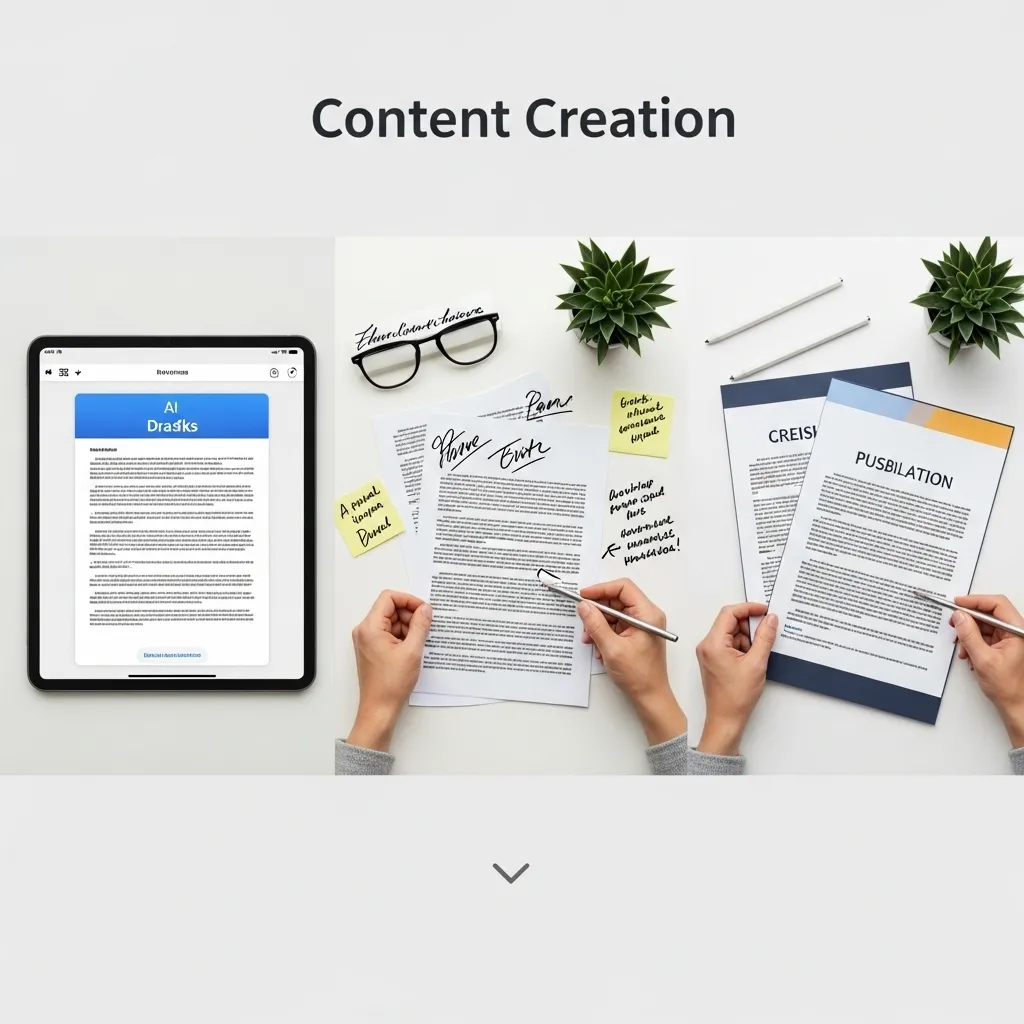
After two years, here’s the content creation process I’ve settled into:
-
Concept and research (human): I determine topic, audience, goals, and gather any necessary research or information.
-
Outline (collaborative): I either create an outline myself or ask Claude to draft one, which I then refine.
-
First draft (Claude-heavy): Using detailed prompts, Claude generates a draft based on the outline.
-
Structural editing (human): I assess whether the structure works, content is accurate, and the piece serves its purpose.
-
Refinement (collaborative): I ask Claude for specific revisions while adding my own edits, insights, and examples.
-
Final editing and polish (human): I do a careful edit for voice, accuracy, flow, and authenticity. This is where I ensure it sounds like me and doesn’t have that AI-generated feel.
-
Fact-checking (human): Any claims, statistics, or factual statements get verified.
This process typically cuts content creation time by 40-60% while maintaining quality that meets my standards.
Platform-Specific Considerations
Different platforms and content types require different prompt approaches.
For LinkedIn: Emphasize professional tone but encourage conversational style. Explicitly say to avoid corporate jargon. Request clear paragraph breaks and white space.
For Twitter/X: Character limits are critical. Request punchy, direct language. Avoid fluff words.
For newsletters: Personal connection matters more. Ask Claude to write in first person and include conversational asides.
For website copy: Benefits over features. Clear hierarchy. Scannable structure.
For long-form articles: Varied sentence structure. Natural transitions. Examples and specificity.
Being explicit about platform norms helps Claude adapt appropriately.
Measuring What Works
I track several metrics to evaluate whether my Claude-assisted content performs:
Engagement metrics: Time on page, scroll depth, comments, shares—do people actually read and engage?
SEO performance: Rankings, organic traffic, click-through rates—does it perform in search?
Conversion metrics: Email signups, link clicks, lead generation—does it drive desired actions?
Qualitative feedback: Comments, emails, conversations—how do real readers respond?
In my experience, well-prompted Claude content that’s been properly edited performs indistinguishably from fully human-written content on these metrics. The key is “well-prompted” and “properly edited.”

The Future of AI-Assisted Content Creation
Even in 2026, this field is still evolving rapidly. Some developments I’m watching:
Better context handling: Claude’s ability to maintain context over longer interactions keeps improving, making iterative content development smoother.
Multimodal integration: The ability to work with images, data, and text together is creating new possibilities for content creation.
Specialized models: Industry-specific fine-tuned versions are emerging, though general models remain remarkably versatile.
Integration tools: The ecosystem of tools that incorporate Claude into content workflows continues expanding.
The fundamental skill—knowing how to prompt effectively and edit intelligently—will remain valuable regardless of technological advancement.
Final Thoughts from the Trenches
Two years into creating content with Claude, I’m neither a skeptic nor a evangelist. It’s a powerful tool that has genuinely changed how I work, but it’s not magic and it’s not a replacement for human expertise, judgment, and creativity.
The prompts I’ve shared here work for me, but effective prompting is ultimately about understanding your specific needs, your audience, and how to communicate those clearly. The best prompt for your project will be one you develop through experimentation and iteration.
Start with these frameworks, but don’t treat them as sacred formulas. Adjust based on what you’re creating, who it’s for, and what results you’re getting. Pay attention to what works and do more of that.
Use Claude to handle the heavy lifting of drafting and structuring. Use your human brain for strategy, insight, accuracy verification, and that final polish that makes content feel authentic and valuable.
The goal isn’t to generate content faster just for the sake of volume. It’s to create better content more efficiently—work that genuinely serves your audience while making your life as a creator more sustainable.
That’s the sweet spot where AI-assisted content creation actually delivers on its promise.