How to Use Claude AI for Beginners: A Straightforward Guide Based on Real Experience
How to Use Claude AI for Beginners: A Straightforward Guide Based on Real Experience
I’ll admit it—when I first heard my colleague raving about Claude AI back in early 2024, my eyes glazed over a bit. Another AI tool to learn? I was already juggling enough software subscriptions and platforms. But she kept at it, showing me how she’d used it to condense a 50-page industry report into actionable insights in minutes, and eventually I caved. That was almost two years ago, and I’ve been using Claude multiple times a day ever since.
What I wish someone had told me from the start is this: you don’t need to be technical, you don’t need special training, and you absolutely don’t need to spend hours watching tutorials. Claude is fundamentally about having useful conversations. If you can describe what you need in plain English (or several other languages), you can use Claude effectively.
This guide is what I would’ve wanted as a complete beginner—practical, jargon-free, and focused on what actually matters.
Understanding What Claude Actually Does
Before we get into the mechanics, let’s clear up what Claude is and isn’t. Claude is a conversational AI developed by Anthropic. You type something, it responds intelligently. You can ask questions, request help with tasks, upload documents for analysis, work through problems—all through a text-based conversation.
It’s not a search engine that scours the internet for links. It’s not an autonomous agent that goes off and does things for you. It’s more like having an exceptionally knowledgeable assistant who can help you think through problems, draft content, analyze information, learn new topics, and handle a wide variety of language-based tasks.
What makes Claude distinct from other AI chatbots—and I’ve tried ChatGPT, Gemini, and several others—is its approach to responses. Claude tends to be more thoughtful, more willing to acknowledge nuance and uncertainty, and generally less prone to the overconfident nonsense that plagued earlier AI systems. It feels more like conversing with someone who thinks before speaking.
As of 2026, Claude has several versions. Claude 3.5 Sonnet is the workhorse model that balances capability with speed—this is what most people use for everyday tasks. Claude Opus is the heavyweight for complex reasoning and analysis. There’s also Claude Haiku for simpler, faster tasks, though most beginners won’t need to worry about model selection initially.

Getting Started: Access and Setup
Let me walk you through the actual process of getting started in 2026, because the landscape has shifted somewhat from the early days.
The Free Route
Head to claude.ai and create an account. You’ll need an email address or can sign in through Google, Apple, or several other authentication methods depending on your region. The free tier is surprisingly generous—you get access to Claude 3.5 Sonnet with usage limits that reset monthly. For someone just learning the ropes or using Claude casually, free access might be all you need indefinitely.
I used the free version for about four months before upgrading, and only did so because I started hitting the usage cap regularly. If you’re testing the waters, don’t feel pressured to pay for anything yet.
Claude Pro: When and Why
The Pro subscription runs $20-24 monthly depending on your location. What you get:
- Significantly higher usage limits (I’ve never hit them even with heavy use)
- Access to Claude Opus for complex tasks requiring deeper reasoning
- Priority access during peak times when servers are busy
- Early access to new features
I upgraded when I realized I was rationing my Claude usage to stay under the free limit, which defeated the purpose. If you find yourself doing that within the first few months, Pro is probably worth it. If you’re using Claude a few times a week, stick with free.
Mobile Apps
Both iOS and Android apps work smoothly now, which wasn’t the case in the early rollout. Your conversations sync seamlessly across devices. I probably use the mobile app for about 40% of my Claude interactions—quick questions while commuting, brainstorming ideas while walking, or getting help with something when I’m not at my desk. Download the app early; you’ll use it more than you expect.
Browser Extensions and Integrations
There’s a growing ecosystem of browser extensions and third-party tools that incorporate Claude. My advice? Ignore these for now. Learn how to use Claude through the official interface first. Once you’re comfortable, you can explore integrations if they solve specific problems for you.
Your First Conversation: What to Actually Do
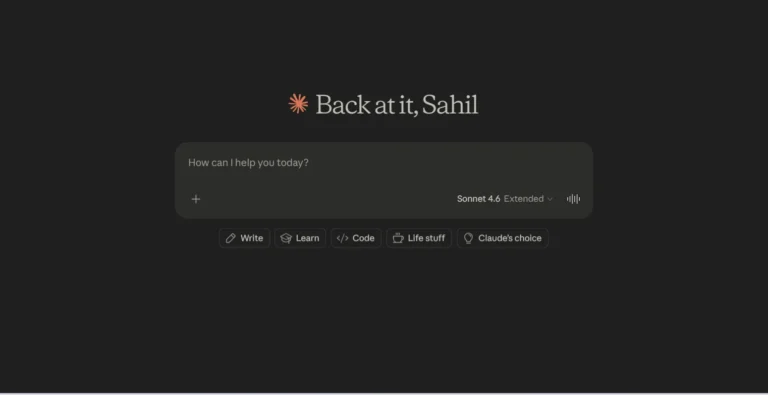
Open Claude. You’re looking at a clean interface with a message box at the bottom. This simplicity is deliberate—you’re not supposed to configure settings or adjust parameters. Just talk.
Here’s where beginners often get stuck: they’re not sure what to ask or how to phrase it. Let me give you a starting point that’s worked for everyone I’ve introduced to Claude.
Start with something you genuinely need help with. Not a test question, not something you already know the answer to, but an actual task or question from your real life. This makes the learning process immediately useful rather than academic.
When I was teaching my sister to use Claude last month, she was struggling to write a thank-you email to a potential client who’d referred business her way. Her exact first message to Claude was:
“I need to write a thank-you email to someone who referred a new client to my graphic design business. The tone should be warm and professional but not overly formal. Can you help me draft this?”
Claude gave her a solid draft that she then personalized with specific details. Took maybe five minutes total instead of the hour she’d been procrastinating. More importantly, she immediately understood how Claude could be useful to her specifically.
So right now, think of something you’re actually working on. Could be:
- An email you need to send
- A topic you’ve been wanting to understand better
- A decision you’re trying to think through
- Something you need to write or organize
- A problem you’re stuck on
Type a clear description of what you need. Be conversational—write like you’re explaining to a helpful colleague.

The Core Skill: Asking Well
The single most important skill for using Claude effectively isn’t technical—it’s learning to describe what you need clearly. This sounds obvious, but it’s where most value gets unlocked or lost.
Bad prompt: “social media tips”
This is vague to the point of uselessness. Social media tips for what? For whom? What platform? What goal?
Better prompt: “I run a small plant nursery and want to use Instagram to attract more local customers. I can spend about 30 minutes a day on this. What are the most important things I should focus on to actually get results?”
See the difference? The second version provides:
- Context (plant nursery)
- Platform (Instagram)
- Goal (attract local customers)
- Constraint (30 minutes daily)
- What success looks like (actual results)
Claude can work with the vague prompt, but you’ll get generic advice that may not fit your situation. The specific prompt gets you targeted, actionable guidance.
Here’s my rule of thumb: include the who, what, why, and any important constraints. Doesn’t need to be formal—just clear.
Who: Who is this for? (Your audience, yourself, your team)
What: What specifically do you need? (Draft, explanation, analysis, ideas)
Why: What’s the goal or context?
Constraints: Any limitations or requirements? (Time, budget, format, tone)
This framework has served me well across hundreds of different requests.
The Follow-Up: Where Real Value Happens
Here’s something that took me embarrassingly long to figure out: the first response isn’t supposed to be the final answer. Claude maintains context throughout a conversation, which means you can refine, adjust, and dig deeper.
Let’s say Claude gives you a response that’s 70% of what you need but not quite right. Don’t start a new conversation. Just tell Claude what to adjust:
“This is helpful, but can you make it more concise? I need to keep it under 200 words.”
“Good start, but the tone is too formal for my audience. Can you make it more conversational?”
“You focused on theory, but I need specific, practical steps I can implement this week.”
“Actually, I realized I need to approach this differently. Instead of [X], can we focus on [Y]?”
I probably refine responses at least half the time. That’s not a failure—it’s how the tool is meant to work. You’re collaborating, not just extracting information.
Real-World Applications That Work
Let me share the most common ways I’ve seen beginners successfully use Claude once they get past the initial learning phase.
Writing Assistance
This is the most popular use case by far. I use Claude for:
Email drafting when I need to get the tone right or organize my thoughts coherently. Just last week: “I need to tell my team that we’re changing our meeting schedule, which I know some people won’t love. Help me draft an email that’s clear about the change, acknowledges it might be inconvenient, and explains the reasoning.”
Content outlining before I write articles, reports, or presentations. “I’m writing about renewable energy trends for a business audience. Help me outline the key sections I should cover to make it comprehensive but not overwhelming.”
Editing and refinement of existing text. You can paste something you’ve written and ask Claude to tighten it up, check for clarity, suggest improvements, or adjust the tone.
Important caveat: Always edit what Claude produces. Add your personal voice, verify facts, adjust for your specific context. Claude provides scaffolding, not finished products.
Learning and Research
This has become my preferred method for quickly getting up to speed on new topics.
Example: I needed to understand blockchain technology for a project but had zero background. Instead of reading through lengthy articles with varying quality, I had a conversation with Claude where I could ask exactly what I needed and follow up when something wasn’t clear.
My opening: “Explain blockchain technology to me. I’m comfortable with general tech concepts but have no cryptocurrency or cryptography background. Start with the core idea.”
From there, I could ask:
- “How does that actually prevent tampering?”
- “Give me a real-world example beyond cryptocurrency”
- “What are the main limitations?”
- “How is this different from just having a database?”
Within 20 minutes, I had a functional understanding that would’ve taken hours of reading and researching on my own.
This conversational learning approach is remarkably effective because you’re directing the pace and focus based on your actual comprehension, not someone else’s assumption about what you need to know.
Document Analysis
The ability to upload documents and have Claude analyze them has become one of my most-used features.
Common scenario: You receive a lengthy report, contract, research paper, or set of meeting notes. You need to understand the key points but don’t have time to read 40 pages carefully.
Upload the document to Claude and ask things like:
- “Summarize the main arguments in this report”
- “What are the key action items from these meeting notes?”
- “Identify any potential risks or concerns in this contract”
- “Compare the conclusions in these two research papers—where do they agree and disagree?”
Last month I had three different proposals from vendors (total of about 60 pages). I uploaded them and asked: “Compare these proposals focusing on pricing structure, timeline, and included services. Highlight the key differences that would affect my decision.”
Saved me hours of back-and-forth page flipping. I still read the final documents carefully before making a decision, but Claude helped me quickly identify what actually mattered.
Problem-Solving and Decision-Making
Claude is excellent at helping you think through complex problems from multiple angles.
I used this when deciding whether to hire for a new position or outsource that work. My prompt:
“I’m trying to decide between hiring a full-time junior marketing person (roughly $55K salary plus benefits and overhead) versus outsourcing marketing tasks to freelancers as needed. My current marketing spend on freelancers is about $2K monthly. Help me think through this decision—what factors should I weigh? What am I potentially overlooking?”
Claude laid out considerations I hadn’t fully thought through: management time required for an employee, flexibility differences, ramp-up period, skill diversity from multiple freelancers versus depth from one person, long-term scalability. It didn’t make the decision for me, but it gave me a more comprehensive framework for thinking it through.
Brainstorming and Ideation
When you’re stuck or need fresh angles on something, Claude is useful for generating options and perspectives.
My friend runs a coffee shop and was planning a summer promotion. She asked Claude: “I want to run a summer promotion for my coffee shop to attract more afternoon customers, which is our slow period. What are some creative ideas beyond just discounting drinks?”
Claude generated probably 15 different angles—loyalty programs, partnered promotions with nearby businesses, themed events, seasonal menu items, community engagement activities, subscription models. Not all were relevant, but several sparked ideas she wouldn’t have thought of alone.
The key: treat brainstorming as exactly that—generating possibilities to evaluate, not final solutions to implement as-is.
Making Claude Work Better: Practical Techniques
Once you’ve used Claude for a week or two, these intermediate techniques will noticeably improve your results.
Give Examples
If you want Claude to match a particular style, tone, or format, show an example.
“I need product descriptions similar to this one: [paste example]. Match the tone and structure, but for this product: [your product details].”
This gives Claude a clear template rather than having to guess what you mean by “engaging” or “professional.”
Ask for Multiple Options
Instead of getting one response and hoping it’s good, ask for variations:
“Give me three different approaches to this presentation opening—one that starts with a story, one that leads with data, and one that poses a provocative question.”
You can then pick the approach that resonates or combine elements from different options.
Use the “Explain Your Thinking” Approach
For complex analysis or reasoning, ask Claude to show its work:
“Walk me through your reasoning step-by-step” or “Explain why you arrived at this conclusion.”
This is particularly valuable when you’re trying to learn something or need to understand the logic behind a recommendation.
Create Reusable Structures
If you find yourself doing similar tasks repeatedly, develop prompts you can reuse with minor modifications.
I have a saved prompt structure for analyzing competitive positioning:
“I’m analyzing [COMPANY/PRODUCT]. Based on this information [details], help me identify: (1) main competitive advantages, (2) potential weaknesses, (3) market positioning opportunities, (4) key threats. Structure as brief summary plus detailed sections.”
I just swap in the relevant company and information. Saves time and ensures consistent analysis.

The Projects Feature: A Game-Changer for Organization
This rolled out in late 2024 and has become essential to how I use Claude.
Projects let you create separate workspaces for different topics or areas of work. Within each project, you can upload relevant documents and add custom instructions that Claude automatically references for all conversations in that project.
Example: I have a project for client consulting work. I’ve uploaded our standard frameworks, past deliverables as examples, and added custom instructions about our methodology and terminology. Now when I start any conversation in that project, Claude already has this context—I don’t need to re-explain background information every time.
Setting up a project takes maybe 10 minutes but saves hours of repetitive context-setting over time.
How to use it: Click the Projects section, create a new project, give it a name, upload any relevant documents, and add custom instructions if helpful. Then start conversations within that project when working on related topics.
What Claude Gets Wrong (And What to Watch Out For)
Let’s be realistic about limitations, because understanding where Claude struggles is as important as knowing where it excels.
Accuracy Isn’t Guaranteed
Claude can state incorrect information with complete confidence. This has improved dramatically—it’s much more likely now to express uncertainty when it’s not sure—but it still happens.
I learned this when I quoted some market statistics Claude provided in a presentation. Turned out one number was outdated by two years. Not disastrously wrong, but wrong enough to be embarrassing when someone checked.
My rule: Verify important facts, especially statistics, dates, quotes, and technical claims, through independent sources. Use Claude for reasoning and analysis, not as an authoritative reference for factual claims.
Knowledge Cutoff and Current Events
Claude’s training data has a cutoff date. While it’s updated more frequently than it used to be, there’s still a gap between the training cutoff and right now. For current events, breaking news, or real-time data (stock prices, sports scores, latest political developments), Claude isn’t your tool.
It Can’t Access External Systems
Claude can’t browse the internet on your behalf, check your email, access your files (unless you upload them), make purchases, or interact with other software. It’s a conversational interface, not an integrated digital assistant that can take actions across your systems.
Complex Math and Precise Calculations
While Claude can handle basic math and reasoning about quantitative problems, it’s not designed for complex calculations or scenarios requiring extreme precision. For serious number crunching, use appropriate specialized tools.
Highly Specialized Professional Domains
Claude is a generalist. For deeply specialized work—advanced legal analysis, complex medical diagnosis, cutting-edge scientific research—it can provide useful general context but shouldn’t replace domain experts.

Privacy and Security: What You Need to Know
This matters more than most beginners realize initially.
Your conversations with Claude are processed by Anthropic’s systems. While they have robust privacy policies and security measures, you should not share:
- Confidential business information
- Personal identifying data (SSN, passport numbers, financial account details)
- Passwords or security credentials
- Protected health information
- Anything covered by NDA or confidentiality agreements
- Information you wouldn’t feel comfortable in any cloud service
I use Claude extensively for work, but I’m careful about what I share. If I need to analyze a document with sensitive information, I’ll remove or anonymize identifying details before uploading.
The regulatory landscape has matured significantly. The EU’s AI Act provides clear frameworks for AI usage and data rights. Various U.S. state regulations have established privacy protections. These primarily affect how companies deploy AI, but they also establish your rights regarding data usage and transparency.
Practical approach: Treat Claude like any cloud service. Fine for general work, learning, and non-sensitive information. Not appropriate for highly confidential or legally protected data.
Ethical Considerations: Using Claude Responsibly
There’s ongoing debate about attribution and transparency when using AI assistance. Standards are still evolving, but here’s my approach based on current professional norms:
I mention AI assistance when:
- Publishing content where Claude substantially contributed to drafts or research
- Submitting work in academic contexts
- Creating analysis or recommendations where the method matters
- It’s relevant to how I reached conclusions
I don’t mention it when:
- Claude was just one tool among many (like spell-check or a thesaurus)
- Personal projects where attribution isn’t relevant
- The final product is substantially my own thinking with Claude used for ideation
The key question: Would someone reasonably expect to know that AI was involved? When in doubt, err toward transparency.
There’s also the question of over-reliance. Claude is a tool to augment your capabilities, not replace your thinking. If you find yourself unable to write, analyze, or solve problems without AI assistance, that’s worth reflecting on. The goal is enhancement, not dependency.

Common Beginner Questions
“How do I know if I’m using it right?”
If you’re getting useful results that help you accomplish real tasks, you’re using it right. There’s no single correct way to interact with Claude. The measure is whether it’s actually valuable to you.
“How much should I rely on Claude’s responses?”
For brainstorming, drafting, learning, and analysis: substantially, but with critical thinking and verification. For final decisions, factual accuracy, or high-stakes situations: use Claude as one input among multiple sources of information.
“Is it cheating to use Claude for work/school?”
This depends entirely on context and rules. In many professional settings, using appropriate tools is expected and valuable. In academic settings, policies vary—check with instructors. The ethical question is whether you’re representing AI work as your own original thinking when that misrepresents your contribution.
“Why do I sometimes get different answers to the same question?”
Claude doesn’t simply retrieve stored answers—it generates responses based on the input. Small variations in how you phrase questions or different contexts can lead to different responses. This isn’t a flaw; it’s how the system works. If consistency matters, be more specific about what you want.
“How long does it take to get good at using Claude?”
Most people feel comfortable with basic use within a few hours of active experimentation. Getting genuinely skilled at extracting maximum value takes a few weeks of regular use as you learn what works well for your specific needs. It’s not a steep learning curve.
Your First Week: A Suggested Approach
If you’re starting from zero, here’s how I’d recommend spending your first week:
Days 1-2: Exploration
Just mess around. Ask Claude to explain things you’re curious about. Request help with something you’re actually working on. Try different ways of phrasing requests. Don’t worry about doing it “correctly”—just get comfortable with the basic interaction.
Days 3-4: Focused Application
Pick one specific use case that’s relevant to you—writing assistance, learning a topic, document analysis, whatever fits your needs. Spend some focused time using Claude for that purpose. Go deeper rather than broader.
Days 5-6: Refinement
Pay attention to what produces good results versus mediocre ones. Notice patterns. When do you get the most value? What makes prompts effective? Start being more intentional about how you interact.
Day 7: Reflection and Planning
Think about how Claude might fit into your regular workflow. What would you use it for weekly? What’s not a good fit? Start building habits around the valuable use cases.
After this first week, you should have a functional understanding and 2-3 specific ways you know Claude is useful for you personally.

Looking Forward: What’s Developing
AI technology continues evolving rapidly. Without venturing into speculation, some clear trends:
Multimodal capabilities keep improving—the integration of text, images, documents, and eventually other formats becomes more seamless and powerful.
Longer context windows allow Claude to handle increasingly large documents and maintain coherent context through longer conversations.
Specialized versions for particular industries or applications are emerging, though the general model remains remarkably versatile.
Integration ecosystem continues expanding—more third-party tools and platforms incorporating Claude functionality.
The fundamental skill—knowing how to communicate clearly about what you need—will remain valuable regardless of technological evolution.
Final Thoughts
I’ve been using Claude regularly for nearly two years now, and I’ve watched probably two dozen people go from “I don’t get the point” to “I use this almost daily.” The pattern is always similar: initial uncertainty, then a moment when it clicks because Claude solves a real problem they have, then gradual integration into their regular workflow.
The barrier to entry is genuinely low. You don’t need technical skills, special training, or hours of preparation. You need curiosity and the willingness to experiment a bit.
Start with something you actually need help with. Be clear about what you want. Refine through follow-up questions. Verify important information. Edit and personalize outputs. Think of Claude as a capable assistant, not an oracle or replacement for your own judgment.
What you get out of it depends on what you bring to the conversation. The technology is a tool—powerful and versatile, but still just a tool. The value comes from how thoughtfully you apply it to real problems and needs.
The best way to learn is to start. Open Claude, describe something you need help with, and see where the conversation goes. You’ll figure out the rest as you go.