AI Coding Tools for Beginners: Learning to Program in the Age of Intelligent Assistants
AI Coding Tools for Beginners: Learning to Program in the Age of Intelligent Assistants
The first time I tried to learn programming was in 2009. I spent three hours debugging a “Hello, World” program because I’d missed a semicolon. Three hours. Looking at a syntax error I didn’t understand, Googling desperately, reading forum posts from 2004 that sort of addressed my problem but not quite.
Fast forward to last month when I watched my niece learn Python. She’s 16, interested in game development. She made the same semicolon mistake (wrong language, but similar issue). Her AI assistant immediately flagged it, explained what a syntax error was, showed her where the problem was, and suggested the fix. She was past “Hello, World” and building a number guessing game within her first hour.
I had two simultaneous reactions: “Wow, that’s amazing” and “Wait, is she actually learning?”
That tension sits at the heart of using AI coding tools as a beginner. These tools are phenomenally powerful—they can accelerate learning, explain concepts, debug code, and build your confidence. They can also become a crutch that prevents you from developing real problem-solving skills.
I’ve spent the last two years teaching introductory programming classes and mentoring career-changers learning to code. I’ve watched students use AI tools brilliantly and disastrously, sometimes within the same week. Here’s what I’ve learned about using AI coding tools effectively when you’re just starting out.
The AI Coding Landscape in 2026
The tools available now are significantly more sophisticated than what we had even two years ago. Here’s what beginners are actually using:
GitHub Copilot
This is probably the most widely used AI coding assistant. It lives in your code editor and suggests code completions as you type—like autocomplete on steroids. The suggestions range from finishing a line to generating entire functions based on your comments.
For beginners, Copilot has gotten much better at understanding context and providing educational explanations. The 2025 update added an “explain mode” specifically designed for learners, which breaks down what suggested code actually does.
I’ve seen beginners use it well as a learning partner. You write a comment describing what you want to do, Copilot suggests code, and you study that code to understand how it works. Used badly, it’s a way to complete assignments without learning anything.
Cost: Free for students and educators; $10/month otherwise as of 2026.
ChatGPT and GPT-5
The general-purpose AI is surprisingly effective for coding help. I use it constantly, and most of the beginners I work with do too.
What makes it good for beginners: you can ask questions in plain English. “Why do I get an IndexError here?” or “Explain what a for loop does like I’m five” or “I’m trying to make a calculator but my code isn’t working [paste code].”
The conversational interface is less intimidating than wading through Stack Overflow for newcomers. But there’s a real risk of using it to do your thinking for you.
Claude (by Anthropic)
Similar to ChatGPT but handles longer code snippets better. I find Claude slightly better at explaining programming concepts because it tends to break things down more thoroughly.
A student learning JavaScript told me Claude was like having a patient tutor available 24/7. She’d paste her broken code, explain what she was trying to do, and Claude would walk her through fixing it step by step.
Replit AI
Replit is an online coding environment, and their integrated AI is particularly beginner-friendly. It understands the context of your project, can explain errors in the console, and suggest fixes.
The advantage for absolute beginners is that everything is in one place—you don’t need to install anything or switch between windows. You code, the AI helps, all in a browser.
Cursor
This is a newer code editor built with AI integration from the ground up. It’s more powerful than Copilot in some ways—you can highlight code and ask questions about it, request refactoring, or have it debug issues.
It’s gained popularity fast, though it’s perhaps more intermediate than beginner-focused. The learning curve for the editor itself can be a barrier if you’re brand new.
Phind
This is a search engine optimized for programming questions. It searches the web but presents answers more conversationally, with code examples and explanations.
I recommend it to beginners over traditional Google searches because it aggregates information better and usually provides working code examples rather than making you piece together answers from multiple Stack Overflow threads.
DeepLearning.AI and Codecademy AI Tutors
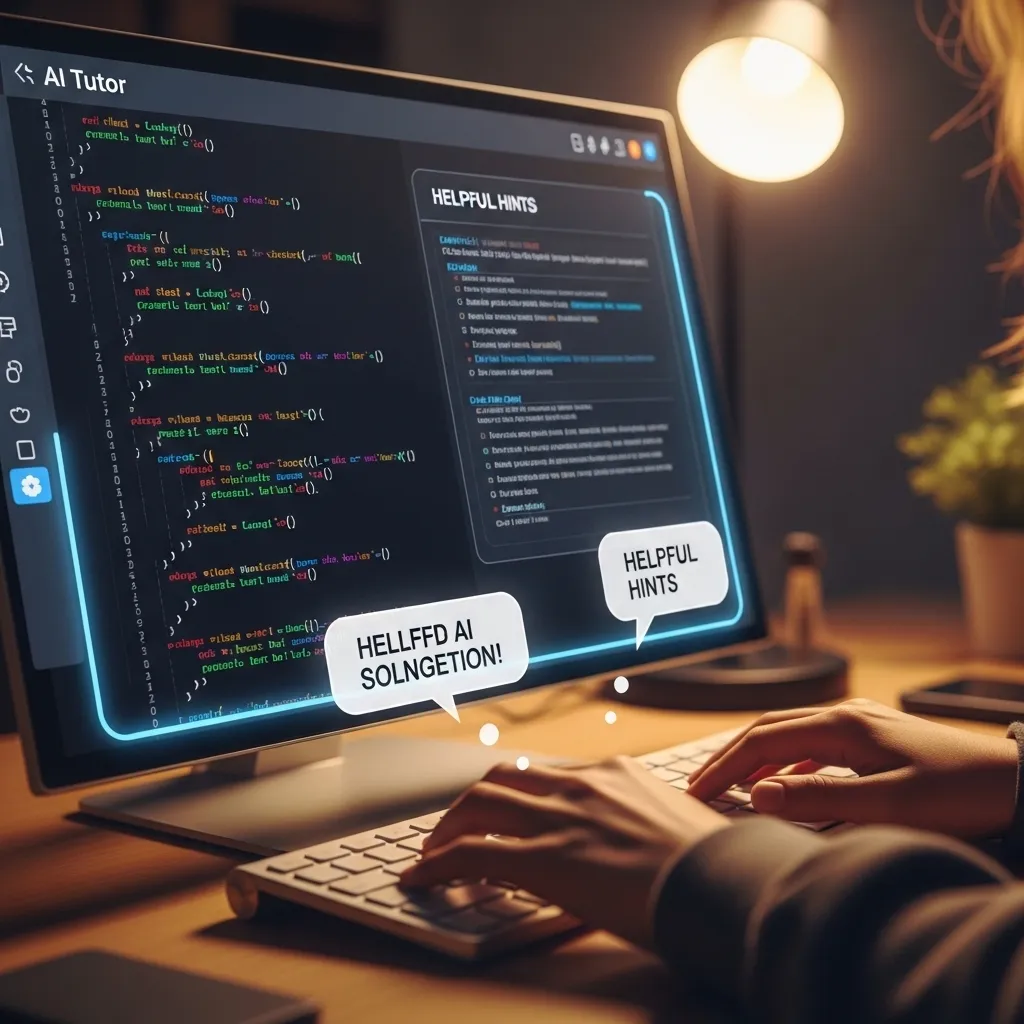
Several learning platforms have integrated AI tutors directly into their courses. These understand the curriculum and can help with specific lessons without giving away the entire answer.
The advantage is that they’re tuned to help you learn rather than just solve the problem. A good AI tutor will guide you to the answer rather than just providing it.
How I Recommend Beginners Actually Use These Tools
I’ve developed strong opinions about this through watching what works and what doesn’t. The students who progress fastest and build genuine skills follow patterns I’ll share.
Start Without AI (Yes, Really)
For your first few programs—maybe your first couple of weeks—struggle without AI assistance. This feels counterintuitive, but it’s crucial.
When you experience the frustration of a bug you can’t immediately fix, you develop problem-solving resilience. When you finally figure out why your loop runs infinitely, that insight sticks in a way that having AI explain it wouldn’t.
I had a student, Marcus, who was learning Python for a data analyst career change. He insisted on using ChatGPT from day one for everything. His homework was always perfect. Then came the assessment without AI access—he couldn’t complete basic problems he’d “solved” weeks earlier. He hadn’t actually learned.
We backed up. He spent two weeks working through basic problems without AI help. It was harder and slower. But when he returned to using AI tools, he used them completely differently—as a learning aid rather than a solution generator.
Use AI for Explanation, Not Generation
The most important distinction: use AI to understand concepts and debug code you’ve written, not to write code for you in the first place.
Good use: “I wrote this function but I’m getting a TypeError. Here’s my code [paste]. What’s wrong?”
Bad use: “Write a function that takes a list and returns the sum of even numbers.”
The first helps you learn from your mistakes. The second prevents you from making mistakes in the first place, which sounds good but is actually terrible for learning.
The “Understand Before You Use” Rule
If AI suggests code and you don’t understand every single line, don’t use it until you do.
This means asking follow-up questions: “What does enumerate() do in this code?” “Why did you use a while loop instead of a for loop?” “Can you explain line 7?”
I watched a beginner named Priya implement this rigorously. She’d get AI suggestions, then spend time ensuring she understood each component. She’d often rewrite AI suggestions in a simpler way she understood better, even if it was slightly less elegant. Six months later, she barely needed AI help anymore—she’d internalized the patterns.
Try First, Then Ask
Before asking AI for help, attempt the problem yourself for at least 15-20 minutes. Get stuck. Try debugging. Read error messages.
Then use AI to get unstuck. “I’m trying to [goal]. I’ve tried [approach] but I’m getting [error]. Here’s my code. What am I missing?”
This gives AI context and ensures you’ve engaged with the problem first. It also helps you develop the critical skill of articulating what you’re trying to do and what’s going wrong.
Compare Multiple Solutions
When AI provides a solution, don’t just accept it. Ask: “Can you show me two other ways to solve this?” or “What’s a simpler approach for a beginner?”
Seeing different approaches helps you understand there isn’t one “right” way to code. It also helps you recognize patterns across solutions.
Debug Before Asking for Help
When you get an error, read the error message carefully. Try to interpret it. Google specific error messages. Only then ask AI.
Error messages are actually incredibly informative once you learn to read them. If you immediately ask AI about every error, you never develop the skill of understanding what the interpreter or compiler is telling you.
One student had a breakthrough when I made him spend a full day debugging without AI. He learned that “list index out of range” means you’re trying to access a position that doesn’t exist, and he developed an intuition for why that happens. Now he catches those errors before running the code.
The Learning Path: When to Introduce Which Tools
Based on teaching dozens of beginners, here’s the progression I recommend:
Weeks 1-2: No AI Assistance
Learn the absolute basics—variables, data types, basic operations, simple conditionals—without AI. Use traditional resources: books, courses, documentation.
You need to struggle a bit. This builds foundational problem-solving skills.
Weeks 3-4: AI for Explanation Only
Start using ChatGPT or Claude, but only to explain concepts you don’t understand. Not to write or fix code—just to clarify ideas.
“Explain what a function is and why I’d use one” is fine. “Fix my function” is not.
Weeks 5-8: AI for Debugging Help
Now you can use AI to help debug your code. But follow the process: try fixing it yourself first, read error messages, make attempts, then ask for guidance.
Crucially, don’t just copy AI’s fixed code. Understand why it’s different and what you were doing wrong.
Weeks 9-12: AI as a Coding Partner
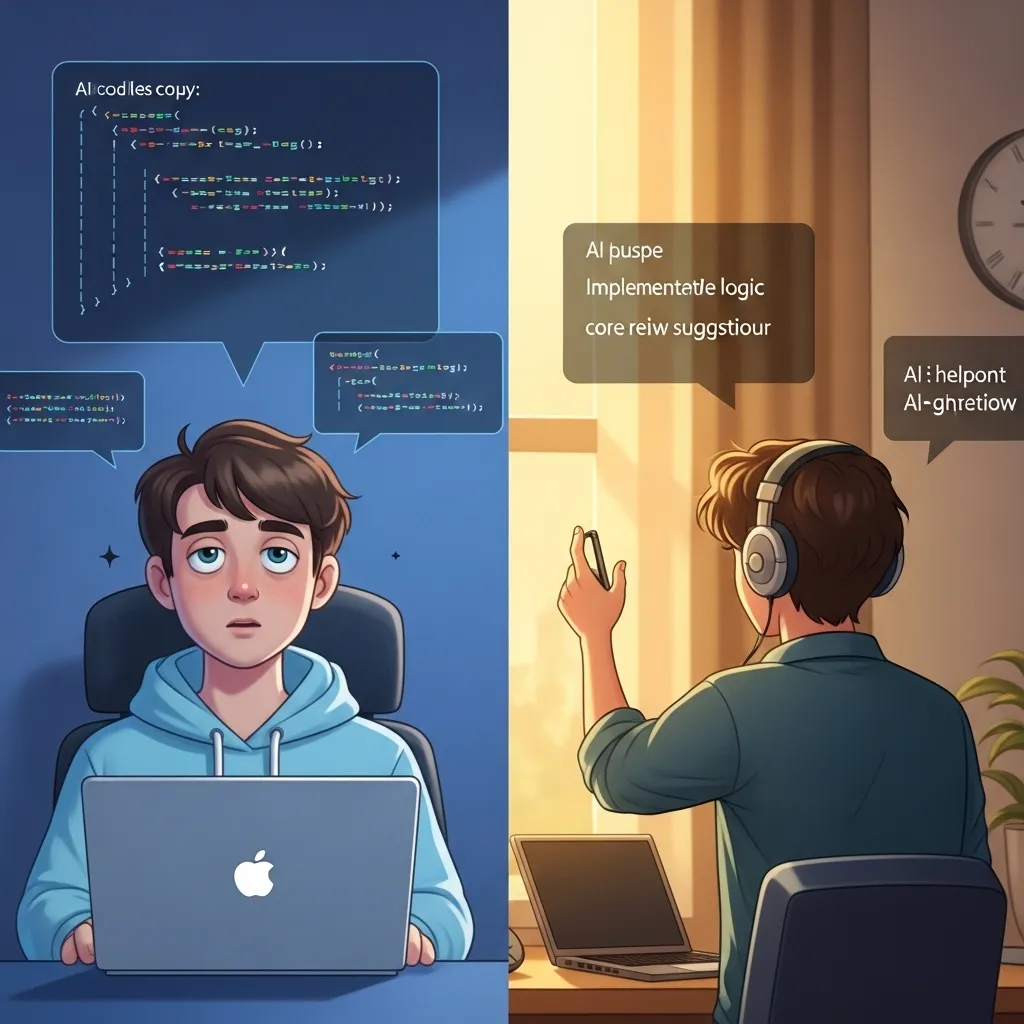
You can start using tools like Copilot, but critically evaluate suggestions. Use AI to generate boilerplate or standard patterns you understand, but implement the core logic yourself.
This is also when you can use AI for code reviews: “Can you review this code and suggest improvements?”
Month 4+: Full Toolset
Now you have enough foundation to use the full range of AI tools responsibly. You can use AI to accelerate learning new concepts, explore advanced patterns, and increase productivity.
But you’ve built the skills to evaluate AI suggestions, catch errors, and understand what you’re implementing.

Real Examples: Good vs. Bad AI Usage
Let me show you the difference with actual scenarios I’ve encountered.
Example 1: Building a Todo List App
Bad Approach:
Student asks ChatGPT: “Build me a todo list app in Python with add, remove, and display functions.”
AI provides complete code. Student copies it, submits it, doesn’t understand how dictionaries work or why the code uses a while loop for the menu.
When asked to add a “mark complete” feature, student can’t do it without asking AI again.
Good Approach:
Student sketches out on paper what functions they need. Writes basic structure themselves. Gets stuck on how to store todo items.
Asks ChatGPT: “I’m building a todo app. What’s a good way to store todo items with their completion status? Just explain the options, don’t write code yet.”
AI explains lists, dictionaries, and classes. Student researches dictionaries, decides that makes sense, implements it themselves with some syntax errors.
Uses AI to debug the syntax errors after attempting fixes. Ends up with a working app they fully understand.
The second student can now add features independently. The first student learned almost nothing.
Example 2: Understanding Recursion
Bad Approach:
Student finds recursion confusing. Asks ChatGPT: “Write a recursive function to calculate factorial with comments explaining it.”
Reads the code and comments. Thinks they understand. Moves on.
Next week, can’t implement a recursive function for a different problem because they never actually grasped the concept.
Good Approach:
Student finds recursion confusing. Asks ChatGPT: “Explain recursion using a non-coding example.”
AI explains with a Russian nesting doll analogy. Still confused.
Asks: “Show me the simplest possible recursive function with step-by-step explanation of what happens when you call it.”
Studies the explanation. Tries writing their own simple recursive function (countdown from 10). Gets a stack overflow error.
Debugs, realizes they forgot the base case. Now understands why base cases matter. Then uses AI to check if their understanding is correct.
The second approach leads to actual understanding that transfers to new problems.
Example 3: Web Scraping Project
Bad Approach:
Student wants to scrape weather data. Asks AI: “Write Python code to scrape weather data from [website].”
Runs the code. It works. Submits it for a project. Doesn’t understand requests library, HTML parsing, or error handling.
The website changes its structure slightly—code breaks. Student has no idea how to fix it.
Good Approach:
Student researches web scraping basics. Learns about requests and BeautifulSoup. Tries writing simple code to get a webpage.
Gets stuck on parsing HTML. Asks AI: “I’m trying to extract temperature from this HTML [paste]. I understand I need to find the right tag, but I’m not sure how. Can you explain how to approach this?”
Learns about finding elements by class or id. Implements it. Gets wrong data because they targeted the wrong element.
Uses AI to review their approach and explain what they’re missing. Eventually builds working scraper and understands each component.
When the website changes, they can debug and fix it because they understand the principles.
Common Mistakes I See Beginners Make
Mistake 1: Copying Without Understanding
The biggest issue. AI provides code, student copies it, code works, student moves on without learning anything.
You’ll know you’re doing this if you can’t explain what each line does. The fix: force yourself to comment every single line explaining what it does in your own words.
Mistake 2: Not Reading Error Messages
AI has made some students lazy about reading errors. They see red text, immediately paste into ChatGPT.
Error messages are teaching tools. Read them first. Try to understand them. You’ll learn to recognize patterns and fix issues faster than AI can explain them.
Mistake 3: Asking for Complete Solutions
“Build me an X” is almost always the wrong prompt for a beginner. You learn nothing from complete solutions generated from scratch.
Ask for guidance, explanations, debugging help, or reviews of your code. Not for finished products.
Mistake 4: Not Testing AI’s Code
AI makes mistakes. I’ve seen beginners assume AI code is perfect, run it, and get wrong results without realizing.
Always test code AI provides. Understand it, run it with different inputs, check edge cases. AI is a tool, not an oracle.
Mistake 5: Using AI for Every Small Thing
Some beginners interrupt their flow constantly to ask AI about minor syntax issues. “How do I append to a list?” “What’s the syntax for an if statement?”
Look these up yourself a few times. Write them down. Make reference notes. Common syntax should become automatic, not something you outsource every time.
Mistake 6: Not Progressing Beyond AI
I’ve seen students become dependent. Six months in, they still can’t write a simple loop without AI confirmation. That’s a sign of using AI as a crutch rather than a learning tool.
You should need AI less over time for basic tasks, not the same amount or more. If that’s not happening, you’re not learning—you’re just outsourcing.
The Controversial Take: When AI Hurts Learning
I need to be honest about this. For some beginners, AI tools do more harm than good, at least initially.
Programming requires developing a mental model of how computers execute instructions. You need to internalize concepts like variables storing values, loops repeating actions, functions encapsulating behavior. This takes time and struggle.
AI can short-circuit this process. Instead of wrestling with a problem until you have that “aha!” moment where the concept clicks, you get the answer. The answer might solve your immediate problem, but you miss the deeper learning.
I’ve taught students who learned pre-AI and students who learned with AI from day one. Honestly? The pre-AI students generally have stronger fundamentals. They’re better debuggers. They’re more creative problem-solvers. They’re more resilient when facing unfamiliar challenges.
The AI-from-day-one students can often build things faster initially, but they hit a wall when they encounter problems AI can’t easily solve or when they need to truly understand what’s happening under the hood.
That said, the best current students use AI strategically. They get the benefits—faster feedback, better explanations than many textbooks, 24/7 availability—without losing the fundamentals.
It requires discipline. You have to deliberately choose to struggle sometimes when AI could immediately help. That’s hard.

The Practical Reality: You’re Probably Going to Use AI Anyway
Look, I can tell beginners to limit AI usage, but the reality is these tools exist and they’re incredibly helpful. Most beginners will use them extensively regardless of what I recommend.
So if you’re going to use AI heavily, here’s how to do it without sabotaging your learning:
Rule 1: Never submit code you don’t fully understand. If you can’t explain what every line does and why it’s necessary, you’re not ready to call it your work.
Rule 2: Alternate between AI-assisted and AI-free practice. Do every other practice problem without any AI help. This ensures you’re building independent skills.
Rule 3: Redo AI-assisted work from scratch without AI. Completed a project with heavy AI help? Great. Now rebuild it from scratch without AI. If you can, you learned. If you can’t, you didn’t.
Rule 4: Use AI to learn concepts, not to skip them. Ask AI to explain difficult concepts in multiple ways. Don’t ask it to handle those concepts for you so you never have to learn them.
Rule 5: Regularly test yourself without AI access. Take practice tests, do timed challenges, build projects without using AI. If you can’t perform without AI, you’re not a programmer—you’re an AI operator.

The Tools I’d Actually Recommend Starting With
If I were learning to code today from scratch, here’s the specific toolkit I’d use:
Phase 1 (Weeks 1-4): Learning Fundamentals
- Primary learning: freeCodeCamp, Codecademy, or The Odin Project
- Reference: Official documentation for your language
- AI tool: ChatGPT free tier for explaining concepts only
Phase 2 (Weeks 5-12): Building Skills
- Code editor: VS Code without Copilot initially
- AI assistance: ChatGPT or Claude for debugging help
- Community: Join a Discord or forum for your language to ask questions
- Projects: Build small projects from tutorial ideas, not from AI generation
Phase 3 (Month 4+): Accelerating Learning
- Add GitHub Copilot to VS Code
- Use Phind for researching how to implement features
- Start contributing to open source to see how experienced developers use AI
- Build increasingly complex projects with AI as a collaborative tool

What About Bootcamps and Courses?
Most coding bootcamps and online courses have updated their policies on AI by 2026. Here’s the typical breakdown:
Bootcamps that prohibit AI: Increasingly rare. Most recognize AI is part of modern development and banning it is unrealistic. These programs usually cater to people wanting to prove they learned “the hard way.”
Bootcamps that integrate AI: More common now. They teach you to use AI tools effectively as part of the curriculum. This is probably the most realistic approach—you learn fundamentals while also learning to use industry-standard tools.
Bootcamps with limited AI: Some allow AI for certain tasks (debugging, research) but not others (core assignments). This attempts to balance real-world skills with ensuring students learn fundamentals.
If you’re choosing