Claude AI Use Cases for Business: Real-World Applications and Lessons from Implementation
Claude AI Use Cases for Business: Real-World Applications and Lessons from Implementation
I’ve spent the better part of the last 18 months helping businesses integrate Claude AI into their operations. Not as a vendor trying to sell something, but as a consultant working with companies ranging from 10-person startups to mid-sized enterprises trying to figure out whether AI tools like Claude are genuinely useful or just another overhyped technology they’ll abandon in six months.
The answer, as you might expect, is complicated. I’ve seen Claude deliver remarkable ROI in some contexts and fall completely flat in others. I’ve watched teams become dramatically more productive and watched others waste weeks chasing AI solutions to problems that needed human judgment.
This guide shares what I’ve learned about where Claude actually creates business value in 2026, based on real implementations with real results—both successes and failures.
The Business Context: Why Claude Specifically?
Before diving into use cases, let’s address why businesses are gravitating toward Claude versus other AI options.
The companies I work with typically consider several AI tools. ChatGPT has brand recognition and a massive user base. Gemini has Google’s infrastructure behind it. Microsoft’s AI offerings integrate seamlessly with their enterprise stack. So why do many end up choosing Claude for core business applications?
Three consistent reasons emerge:
More reliable output quality: In business contexts, consistency matters as much as capability. Claude tends to produce more measured, thoughtful responses with less of the breathless hype-speak that plagued earlier AI. When you’re drafting client communications or analyzing business data, this matters enormously.
Better at nuanced reasoning: Business problems rarely have simple answers. They involve trade-offs, context, competing priorities. Claude handles this ambiguity better than most alternatives, making it particularly valuable for analysis and decision support.
Stronger privacy positioning: Anthropic’s commitments around data privacy and the contractual terms for business use have been more straightforward than some competitors. For businesses handling sensitive information, this clarity matters.
That said, Claude isn’t the right choice for every situation. Some businesses find better value in other tools, and hybrid approaches using multiple AI platforms are increasingly common.

Customer Service and Support Applications
This is where I’ve seen the most dramatic and measurable impact.
Tier 1 Support Augmentation
A SaaS company I worked with in late 2025 had a common problem: their support team spent 60% of their time answering repetitive questions that were technically documented but required some context to answer well.
We implemented Claude through their existing support platform (integrated via API) to handle initial customer inquiries. Not as a chatbot talking directly to customers—the company tried that with an earlier AI tool and the results were mixed—but as a support agent assistant.
Here’s how it works:
When a support ticket comes in, Claude analyzes the inquiry against their knowledge base, previous similar tickets, and product documentation (all uploaded to a Claude project). It suggests a response to the support agent, who reviews, personalizes, and sends it.
Results after three months:
- Average response time dropped from 4 hours to 45 minutes
- Support team handling capacity increased by roughly 40%
- Customer satisfaction scores actually improved (from 4.1 to 4.4 out of 5)
- The team was able to focus more on complex issues requiring actual troubleshooting
The key insight: they used Claude to augment human support agents, not replace them. The human reviews every response, adds personalization, catches when Claude misunderstands context, and escalates complex issues. This hybrid approach delivered far better results than pure automation.
What didn’t work: Initially, they tried having Claude handle responses autonomously for “simple” issues. About 15% of these went off-track—missing important context, suggesting deprecated solutions, or misunderstanding the customer’s actual problem. The hybrid approach eliminated these issues.
Internal Knowledge Management
A professional services firm with about 120 employees had a typical problem: massive amounts of institutional knowledge trapped in documents, past proposals, meeting notes, and email threads.
They created a Claude project containing:
- Anonymized past proposals and project documentation
- Internal process documentation
- Meeting notes and decision records
- Industry research and analysis
Employees now query this knowledge base through Claude: “What approach did we take for similar projects in the healthcare sector?” or “What were the key objections when we last proposed this kind of engagement, and how did we address them?”
Impact: New employees get up to speed faster, experienced employees waste less time searching for information, and institutional knowledge doesn’t walk out the door when people leave.
Critical implementation detail: They were careful about data privacy. Everything uploaded was scrubbed of client names and sensitive details. They created clear policies about what could and couldn’t be shared with Claude.
Marketing and Content Operations
Marketing is probably the most popular Claude use case, but also where I see the most misapplication.
Content Creation at Scale
An e-commerce company needed product descriptions for thousands of items. Writing these manually was prohibitively time-consuming, but generic descriptions weren’t converting well.
Their approach: They created a detailed style guide and uploaded examples of their best-performing product descriptions to a Claude project. For each new product, they fed Claude the specifications and asked it to generate a description matching their style and emphasizing benefits over features.
A human editor reviews and adjusts each description—typically taking 2-3 minutes instead of 15-20 minutes to write from scratch.
Results: They increased content production by roughly 5x while maintaining quality that performed as well as human-written descriptions in A/B tests.
What they learned: Initial attempts without a strong style guide produced generic content that performed poorly. The effort invested in creating detailed guidelines and example content was essential.
Market Research and Competitive Analysis
A B2B software company uses Claude to synthesize competitive intelligence. Their marketing team regularly uploads:
- Competitor product announcements
- Industry analyst reports
- Customer review data from various platforms
- News articles about their market
They then ask Claude to identify trends, compare feature sets, analyze positioning strategies, and spot gaps in the market.
This isn’t automated—an analyst reviews everything Claude produces—but it dramatically accelerates the research process. What used to take a day of reading and synthesizing now takes a couple of hours.
Important limitation: Claude can identify patterns in the data you provide, but it can’t go out and research new information. You still need humans gathering the raw intelligence.
Social Media and Campaign Development
A marketing agency I work with uses Claude for campaign ideation and social content development. Their process:
For a new campaign, they brief Claude on the client, target audience, business objectives, and brand voice. They ask for campaign concepts, messaging frameworks, and social content ideas.
Then—and this is critical—their creative team evaluates, selects, and substantially refines these ideas. Claude provides a starting point and generates volume, but human creativity shapes the final output.
What works: Brainstorming, generating variations, overcoming creative blocks.
What doesn’t work: Trying to use Claude-generated content without significant human creativity and refinement. It tends to be competent but not inspired, which isn’t enough for cutting-through creative work.

Sales and Business Development
Sales teams have found some valuable applications, though the value varies considerably by sales model.
Proposal Development
A consulting firm cut proposal development time roughly in half by using Claude to create first drafts.
Their process: They feed Claude the RFP or project requirements, relevant past proposals (anonymized), their standard service descriptions, and team bios. Claude generates a draft proposal structure and content.
A senior consultant then substantially refines this—adding specific insights about the client’s situation, tailoring the approach, adjusting pricing and scope, and ensuring the proposal reflects genuine understanding of the client’s needs.
Time savings: What used to take 8-12 hours now takes 4-6 hours, allowing them to respond to more opportunities and invest more time in truly custom elements.
What’s essential: The human review is not optional. Clients can tell when proposals are generic, and Claude’s drafts need significant personalization to demonstrate genuine understanding and expertise.
Sales Email and Outreach
A B2B sales team uses Claude to help craft personalized outreach emails. They don’t use templates—they provide Claude with information about the prospect (from LinkedIn, company website, news), explain their product’s value proposition, and ask Claude to suggest personalized opening lines and relevant talking points.
The sales rep then writes the actual email, incorporating Claude’s insights but using their own voice and judgment.
Results: Response rates improved from 8% to 12% because outreach became more relevant and personalized without requiring hours of research per prospect.
Key insight: They use Claude to accelerate research and identify angles, not to write emails autonomously. When they tried automated email generation, response rates actually dropped—the emails felt generic despite technically being personalized.
CRM Data Enrichment
A sales operations team uses Claude to clean and enrich messy CRM data. They export records with incomplete or inconsistent information, ask Claude to standardize formats, fill gaps where possible, and flag records needing human review.
This addressed a long-standing data quality problem that was affecting reporting and lead scoring.
Operations and Process Improvement
Some of the less obvious but highly valuable applications are in operational efficiency.
Document Processing and Analysis
A legal services company processes hundreds of contracts monthly. They use Claude to:
- Extract key terms and dates
- Identify non-standard clauses
- Flag potential risks or unusual provisions
- Summarize key obligations
A paralegal or attorney reviews Claude’s analysis, but it dramatically speeds up the initial review process.
Time savings: Initial contract review time reduced by about 60%, allowing them to handle higher volume without proportionally increasing headcount.
Critical caveat: Final legal judgment still requires human expertise. Claude identifies issues for human review; it doesn’t make legal decisions.
Meeting Notes and Action Items
Multiple companies I’ve worked with use Claude for meeting follow-up. Someone takes notes during meetings (or uses a transcription service), then feeds the notes to Claude asking for:
- Summary of key decisions
- Action items with assigned owners
- Outstanding questions requiring follow-up
- Topics tabled for future discussion
The person who ran the meeting reviews and refines this, but it cuts post-meeting administrative work substantially.
Unexpected benefit: This discipline has actually improved meeting quality. When teams know notes will be processed and action items tracked, they’re more focused and decision-oriented.
Standard Operating Procedure Documentation
A manufacturing company used Claude to help document their SOPs, which had existed primarily as tribal knowledge.
Process: Subject matter experts explained processes to Claude conversationally, which converted these explanations into structured SOP documentation. The experts then reviewed and refined.
This lowered the barrier to documentation significantly—talking through a process is much faster than writing formal documentation from scratch.

Human Resources and Talent
HR applications are more sensitive due to bias concerns and regulatory considerations, but there are valuable use cases when approached carefully.
Job Description Creation
HR teams use Claude to draft job descriptions based on hiring manager input about role requirements, team structure, and required skills.
This speeds up the JD creation process and helps ensure consistency in language and structure across roles.
Important consideration: Descriptions are reviewed carefully for language that might be inadvertently biased or exclude qualified candidates. Claude can perpetuate biases present in its training data, so human review with DEI considerations is essential.
Employee Onboarding Materials
A company created an onboarding Claude project containing:
- Company policies and procedures
- Role-specific training materials
- FAQ from previous new hires
- Organizational charts and team information
New employees can ask questions and get immediate, contextual answers rather than hunting through documents or waiting to ask colleagues.
Benefits: New hires feel less lost, existing employees spend less time answering repetitive questions, and onboarding is more consistent.
Limitation: This augments human onboarding, not replaces it. New employees still need human mentorship, relationship building, and cultural integration that AI can’t provide.
Internal Communications
Internal communications teams use Claude to help draft announcements, policy updates, and organizational communications.
They brief Claude on the message, audience, and tone requirements, get a draft, then refine substantially to ensure the communication reflects leadership voice and handles organizational dynamics appropriately.
Where this works: Routine announcements, policy updates, informational communications.
Where it doesn’t: Sensitive organizational changes, layoffs, major strategic pivots—anything requiring deep emotional intelligence and political awareness needs human drafting from the start.
Finance and Data Analysis
Financial applications require particular care due to accuracy requirements, but there are solid use cases.
Financial Report Summarization
Finance teams use Claude to create executive summaries of detailed financial reports. They upload monthly financials and ask Claude to:
- Highlight key metrics and changes from previous periods
- Identify trends requiring attention
- Summarize performance against budget
- Flag anomalies or unusual patterns
The CFO or financial analyst reviews this and adds business context and strategic implications.
Value: Executives get digestible summaries faster, and finance teams spend less time on routine reporting and more on analysis.
Data Validation and Cleanup
A finance operations team uses Claude to help identify inconsistencies in financial data before closing—things like duplicate entries, miscategorized expenses, or unusual patterns suggesting data entry errors.
This catches issues earlier in the close process, reducing the time spent on reconciliation and corrections.
Important note: Claude assists with identification; actual accounting decisions and corrections require human judgment and understanding of the business context.
Budget Planning Support
During budget planning, managers describe their department needs and constraints to Claude, which helps structure budget proposals and identify areas requiring more detailed justification.
This doesn’t replace financial planning, but it helps managers who aren’t financially sophisticated create better-structured budget requests.

Industry-Specific Applications
Different industries have found specialized use cases.
Healthcare Administration
A healthcare provider uses Claude for:
- Summarizing patient chart notes for care coordination (with strict HIPAA compliance protocols)
- Helping draft patient communication (reviewed by medical staff)
- Processing insurance documentation
Critical compliance consideration: They have rigorous data governance ensuring no PHI is shared inappropriately, and all clinical decisions remain with qualified medical professionals.
Legal Services
Beyond contract review mentioned earlier, law firms use Claude for:
- Legal research synthesis (reading case law and identifying relevant precedents)
- Memo drafting (first drafts of legal memoranda)
- Discovery document analysis (identifying relevant documents in large document sets)
Essential caveat: All work is reviewed by licensed attorneys. Claude accelerates certain tasks but doesn’t replace legal expertise or judgment.
Real Estate
A real estate company uses Claude for:
- Property description writing
- Market analysis synthesis
- Client communication drafting
- Comparative market analysis preparation
This allows agents to focus more on client relationships and showings rather than administrative tasks.
Education and Training
Training departments use Claude to:
- Convert subject matter expert knowledge into training materials
- Create quiz questions and learning assessments
- Adapt training content for different audience levels
- Develop scenario-based learning exercises
Implementation Realities: What Actually Matters
After watching numerous implementations, certain patterns separate successful adoption from failed experiments.
Start Small and Specific
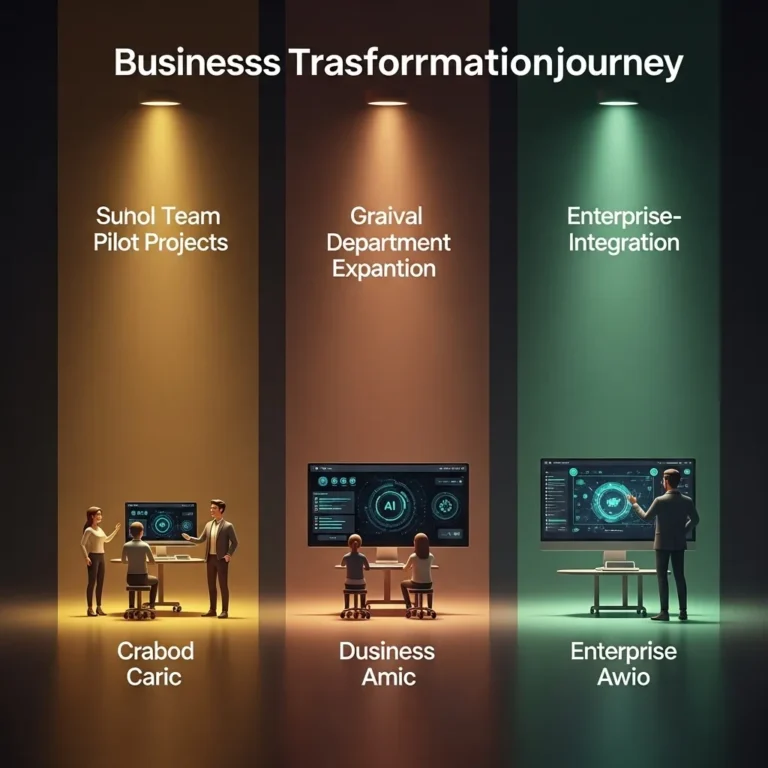
Companies that succeed typically start with one specific use case, prove value, then expand. Companies that try to transform everything at once usually fail.
Successful pattern: “We’re using Claude to help the support team handle product questions more efficiently.”
Failed pattern: “We’re going to use AI to revolutionize our entire operation.”
Human-in-the-Loop is Essential
Every successful business implementation I’ve seen maintains human judgment and review. Pure automation fails more often than it succeeds.
The best results come from viewing Claude as augmentation—making humans more productive—not as replacement.
Data Governance from Day One
Companies need clear policies about:
- What information can be shared with Claude
- How to handle sensitive or confidential data
- Who can access which Claude projects
- How to ensure compliance with relevant regulations
The companies that addressed this upfront had smooth implementations. Those that treated it as an afterthought ran into problems.
Training and Change Management
Introducing Claude isn’t just a technical implementation—it’s a workflow change requiring training and change management.
Successful companies:
- Train employees on effective prompting
- Share internal best practices
- Create guidelines for appropriate use cases
- Recognize and address employee concerns about AI
Companies that skipped this step saw low adoption or inconsistent results.

ROI and Business Case Considerations
The CFOs and financial leaders I work with want concrete numbers. Here’s what we’ve measured across implementations:
Time Savings
Most documented time savings range from 20-50% on tasks where Claude is applied, with significant variation by use case:
- Content drafting: 40-60% time savings
- Research synthesis: 50-70% time savings
- Document analysis: 30-50% time savings
- Customer support: 25-40% reduction in resolution time
Important note: These figures are for tasks where Claude is used, not across entire roles. A content writer might save 50% on drafting time, but drafting is only part of their work.
Cost Considerations
Claude Pro costs $20-25 per user monthly. Enterprise pricing varies based on usage but is generally reasonable compared to other business software.
The bigger costs are often:
- Implementation and integration work
- Training and change management
- Process redesign
- Ongoing management and governance
For most mid-sized businesses, the total cost of ownership in year one (including implementation) is $30K-100K depending on scope. ROI typically becomes clearly positive within 6-12 months if implementation is thoughtful.
Productivity Gains
Beyond time savings, companies report:
- Ability to pursue opportunities they previously couldn’t (more proposals, faster response to RFPs)
- Quality improvements (more thorough research, more consistent output)
- Employee satisfaction (less time on tedious tasks, more on interesting work)
These softer benefits are harder to quantify but often matter more than direct time savings.
What Doesn’t Work: Lessons from Failures
I’ve seen plenty of failed Claude implementations. Common patterns:
Using Claude for Decisions Requiring Judgment
A company tried using Claude to evaluate job applicants based on resumes and cover letters. This went poorly for multiple reasons: potential bias issues, inability to assess cultural fit, missing context about role requirements, and legal risk.
Lesson: Claude can help process information for human decision-making, but it shouldn’t make business decisions autonomously.
Replacing Expertise with AI
A marketing agency tried replacing junior strategists with Claude to save costs. Client work quality suffered because Claude lacks strategic intuition, deep market understanding, and creative thinking.
Lesson: Claude augments expertise; it doesn’t replace it. You still need skilled humans, though they may work differently.
Neglecting Data Quality
A company uploaded years of messy, poorly-organized documentation to a Claude project and expected magic. They got mediocre results because garbage in, garbage out still applies.
Lesson: Claude works with the information you provide. Good results require good input data.
Over-Automation Without Human Review
A company automated client email responses using Claude. Some emails went out with incorrect information or inappropriate tone because nobody reviewed them.
Lesson: Business contexts require human judgment. Automation without review is risky.

Ethical and Practical Considerations
Businesses need to think through several non-technical considerations.
Transparency and Disclosure
When should you disclose that content was AI-assisted? Standards are still evolving, but general principles:
- If customers would reasonably expect human creation (personalized consulting advice, creative work), disclosure is appropriate
- For routine content (product descriptions, routine communications), disclosure is less critical
- When AI assistance is substantial, transparency builds trust
My recommendation: err toward transparency. “This draft was prepared with AI assistance and reviewed by our team” is becoming standard and accepted.
Employment Impact
The honest question: will Claude reduce headcount needs?
What I’ve observed: companies rarely reduce headcount directly because of Claude. Instead:
- They handle higher volume with the same team
- They reallocate employee time to higher-value work
- They grow without proportionally increasing headcount
- Junior employees need to develop stronger critical thinking and judgment skills since routine tasks are increasingly automated
The impact is more about changing work than eliminating it.
Bias and Fairness
Claude can perpetuate biases in its training data. This is particularly concerning in:
- Hiring and HR applications
- Customer-facing communications
- Decision support systems
Mitigation: Human review with explicit attention to bias, diverse reviewers, regular auditing of outcomes, and clear policies about appropriate use.
Competitive Considerations
If everyone in your industry is using Claude, where’s the competitive advantage?
The advantage isn’t in the tool—it’s in how thoughtfully you deploy it. Companies that integrate Claude well and redesign processes appropriately gain advantage. Those that just bolt it on as a superficial productivity hack don’t.
Looking Forward: Trends for 2026 and Beyond
Based on what I’m seeing in implementation projects currently underway:
Deeper Integration: Rather than Claude as a separate tool you consult, it’s increasingly embedded in existing business software and workflows.
Custom Projects at Scale: Companies are creating extensive knowledge bases in Claude Projects, turning it into a powerful internal knowledge management system.
Specialized Applications: Industry-specific use cases are becoming more sophisticated as companies learn what works in their specific context.
Better Governance: Data governance, usage policies, and ethical guidelines are maturing as companies gain experience.
Multi-Modal Capabilities: The ability to work with images, documents, and structured data together is opening new use cases.
API-First Approaches: More sophisticated companies are integrating Claude via API into custom workflows rather than using it as a standalone tool.

Practical Next Steps for Businesses
If you’re considering Claude for your business, here’s what I recommend:
1. Identify a specific, measurable use case: Don’t start with “use AI to improve productivity.” Start with “reduce proposal development time by 30%” or “improve support ticket resolution speed.”
2. Run a pilot: Choose one team or department. Implement carefully, measure results, learn lessons.
3. Establish governance first: Create clear policies about data privacy, appropriate use cases, and review requirements before rolling out broadly.
4. Invest in training: Budget time and resources for teaching people to use Claude effectively. This isn’t optional.
5. Plan for workflow changes: Think through how processes need to adapt. Claude works best when workflows are redesigned around its capabilities, not just bolted onto existing processes.
6. Measure and iterate: Track actual results against expectations. Be willing to adjust based on what you learn.
7. Stay realistic about timelines: Expect 3-6 months to see meaningful results from initial implementation. This isn’t plug-and-play; it requires organizational learning.
Final Thoughts
After 18 months working with businesses implementing Claude, I’m convinced it creates genuine value when deployed thoughtfully. The companies seeing the best results share common characteristics:
- They started with specific, well-defined use cases
- They maintained human judgment and review
- They invested in proper implementation and training
- They treated it as a tool to augment human capabilities, not replace them
- They established clear governance and ethical guidelines
Claude isn’t transformative magic that revolutionizes business overnight. It’s a powerful tool that, when integrated thoughtfully into well-designed processes, makes knowledge workers meaningfully more productive.
The competitive advantage won’t come from simply using Claude—your competitors can do that too. It will come from using it more thoughtfully, integrating it more seamlessly, and combining it with human expertise more effectively than others in your industry.
The businesses winning with Claude in 2026 are those that view it as one element of a broader strategy to work smarter, not a silver bullet that solves all problems.
Start small, measure carefully, learn continuously, and scale what works. That’s the path to real business value from Claude AI.