How to Use AI for Blogging: A Practitioner’s Guide from Three Years in the Trenches
How to Use AI for Blogging: A Practitioner’s Guide from Three Years in the Trenches
I published my first AI-assisted blog post in February 2023, and I was terrified someone would call me out. Not because I was doing anything wrong—I’d heavily edited and added my own insights—but because the stigma around AI-written content was intense back then. Now, in 2026, the conversation has matured considerably. Most professional bloggers I know use AI in some capacity, though how and how much varies wildly.
After running two blogs and helping several clients integrate AI into their content workflows, I’ve learned what actually works versus what sounds good in theory but falls flat in practice. Let me walk you through what I wish someone had told me three years ago.
The Reality Check Nobody Gives You
Let’s get this out of the way first: you cannot just tell ChatGPT “write me a blog post about gardening tips” and publish whatever it spits out. Well, you can, but your readers will know, Google’s algorithms will likely figure it out, and your content will feel as soulless as an airport CNN broadcast.
I learned this the embarrassing way. In my early experiments, I published three posts that were maybe 80% AI-generated with minimal editing. My regular readers noticed immediately. I got emails asking if I’d hired a new writer or if something was wrong. The posts weren’t factually incorrect—they were just… bland. They lacked the voice, the specific examples, the personality that made my blog mine.
That said, AI has genuinely transformed my blogging productivity and capabilities. I now publish twice as often as I did pre-AI, and paradoxically, the quality has improved because I spend less time staring at blank pages and more time refining ideas and adding depth.
The key is understanding what AI should handle and what requires your human brain.

Where AI Actually Helps (Based on Real Use)
Idea Generation and Angle Development
This is where I get the most value, hands down.
I run a blog about urban sustainability, and some weeks I’d sit there knowing I should write something but drawing complete blanks. Now I have a running conversation with Claude (my preferred tool for writing work) where I’ll dump random thoughts, recent experiences, or topics I’m mulling over.
Here’s a real example from last month: I’d been thinking about composting but knew it was an oversaturated topic. I asked Claude: “I want to write about composting for apartment dwellers, but there are already thousands of posts about this. Give me 10 unconventional angles that haven’t been done to death.”
It gave me options ranging from “the psychology of why apartment composting fails” to “composting as a gateway to community organizing.” I ended up writing about the latter, something I wouldn’t have thought of on my own, combining the practical how-to with stories from my apartment building’s composting program.
The AI didn’t write the post—it unstuck me and pointed me toward a fresh angle.
Research and Fact-Gathering
AI has become my first-stop research assistant. I’ll feed it a topic and ask it to explain the main concepts, current debates, or recent developments. This gives me a foundation much faster than spending an hour Googling.
But—and this is crucial—I verify everything important.
I was writing a post about solar panel efficiency and asked ChatGPT for recent statistics. It confidently told me that current panels achieve 35-40% efficiency. That seemed high, so I checked. Turns out commercial panels are still mostly in the 18-22% range, with laboratory records around 47% for specialized cells. The AI had blended different contexts.
So my workflow is: Use AI to get the lay of the land, then verify specific claims through authoritative sources. It’s still faster than starting from scratch, but it keeps me from publishing nonsense.
Outlining and Structure
This might be AI’s secret superpower for bloggers.
I’ll describe my topic, key points I want to cover, and my intended audience. Then I ask for three different structural approaches. Sometimes I use one of them directly. More often, I pull elements from multiple suggestions to create something hybrid.
For a recent post about reducing household energy consumption, I was planning a standard listicle. The AI suggested structuring it as “audit, quick wins, medium investments, long-term changes” instead of just ranking tips by importance. That framework made the post more actionable because readers could choose based on their current situation and budget.
Drafting (With Major Caveats)
I do sometimes use AI to generate first drafts, but not in the way you might think.
I write the outline myself, including specific examples, stories, or data points I want to include. Then I’ll have AI expand each section into full paragraphs. What I get is maybe 30-40% usable—it handles transitions, expands on straightforward points, and gets basic explanations down.
But anything requiring nuance, personal voice, or original insight? I write that myself.
Here’s my typical workflow for a 2,000-word post:
- I spend 30 minutes outlining and gathering my key points/examples (human)
- AI generates a rough draft based on detailed outline (10 minutes)
- I rewrite sections that need personality, add personal anecdotes, fix inaccuracies, adjust tone (60-90 minutes)
- AI helps me tighten prose and catch unclear phrasing (15 minutes)
- Final human polish (20 minutes)
Total time: about 2.5-3 hours versus the 4-5 hours a post used to take me. The time saving is real, but the human contribution is still majority.
SEO Optimization
AI tools have gotten remarkably good at SEO assistance, though you still need to understand the fundamentals yourself.
I use AI to:
- Generate meta descriptions (then I edit them to sound less robotic)
- Suggest related keywords I haven’t considered
- Check if I’m naturally covering semantic variations of my main topic
- Identify gaps in my coverage of a topic
Last week I wrote about rain gardens. I asked ChatGPT: “What related questions would someone researching rain gardens likely have that I haven’t addressed?” It suggested things like maintenance requirements in winter, cost comparisons to other drainage solutions, and local permit requirements—all valid gaps I’d missed.
I’ve also experimented with AI-generated title options. I’ll usually generate 15-20 options, then frankenstein together elements from multiple suggestions. Straight-up AI titles tend to be either too clickbaity or too generic.
Repurposing Content
This is where AI really shines with less downside risk.
I’ll take a 2,000-word blog post I wrote and ask AI to:
- Turn it into a Twitter/X thread
- Create LinkedIn post versions
- Generate email newsletter copy
- Develop an outline for a video script
- Pull out quotable snippets
Since the original content is mine, I’m less worried about AI voice issues. I’m just reformatting, and AI handles that well.
I recently turned a comprehensive guide on native plant gardens into six separate social posts, an email series, and a YouTube script outline—all in about 45 minutes. Doing that manually would’ve taken half a day.
The AI Blogging Tools I Actually Use (2026 Edition)
The landscape has consolidated and specialized since the early wild-west days of 2023.
For Writing and Editing:
- Claude (Anthropic): My daily driver. Better at maintaining context over long conversations, which matters when you’re developing a post through multiple iterations.
- ChatGPT: Still excellent, especially GPT-4 and beyond. I use it for quick tasks and when I want multiple rapid variations.
- Grammarly (now heavily AI-powered): Catches mistakes I miss and suggests tightening wordy sections.
For SEO and Research:
- Perplexity AI: Fantastic for research because it cites sources, making verification easier.
- Clearscope or Surfer SEO: Specialized tools that combine AI with SEO analysis. They’re pricey ($200-300/month) but worth it if you’re serious about organic traffic.
For Ideation:
- Honestly? Just ChatGPT or Claude. The specialized “AI content idea generators” I’ve tried haven’t been better than a good conversation with a general AI assistant.
For Images:
- Midjourney: Still the quality leader for blog featured images, though it requires more skill
- DALL-E 3: More accessible, better at following prompts precisely
- Adobe Firefly: Best for commercial use with fewer licensing concerns
I spend about $50/month total on AI subscriptions for blogging ($20 for ChatGPT Plus, $20 for Claude Pro, $10 for Grammarly). The specialized SEO tools I use intermittently rather than maintaining constant subscriptions.

What Doesn’t Work (Lessons from Failures)
Complete Automation
I tried this. It was a disaster.
In 2024, I experimented with an automated workflow: RSS feeds triggered AI to write posts about news in my niche, which auto-published to my blog. I thought I’d discovered passive income genius.
Three weeks in, the AI had:
- Published a post contradicting something I’d written the month before
- Completely missed the nuance on a controversial topic, making me look tone-deaf
- Generated a post about “sustainable living tips” that included advice to “grow your own tobacco to save money” (I wish I was joking)
I killed the experiment and spent a week cleaning up the mess. Automation without human oversight is a recipe for embarrassment.
Personality-Heavy Content
AI cannot replicate your unique voice for opinion pieces, personal essays, or anything where your perspective is the entire point.
I write a monthly column sharing personal sustainability successes and failures. I tried having AI draft one based on bullet points about my month. What came back was technically about my experiences but read like someone else describing my life. It was uncanny valley in text form.
These pieces I now write entirely myself. It’s not faster, but it’s the only way they work.
Anything Requiring Recent Events or Expertise
AI training data has cutoff dates, and even with web browsing capabilities in 2026, they’re not reliable for breaking news or highly specialized technical content.
I learned this when writing about local policy changes. The AI confidently explained provisions of a bill that had been amended before passage. I caught it only because I’d attended the city council meeting.
For specialized topics in my field (I have a background in environmental science), I fact-check everything. For topics outside my expertise, I either bring in expert quotes or stick to general, well-established information.

The Ethics Conversation We Need to Have
This might be the most important section, and it’s where many blogging guides gloss over uncomfortable truths.
Disclosure: Should You Tell Readers?
I wrestled with this for months. Currently, my approach is:
- I don’t add a disclaimer to every post (“this was partially written with AI assistance”)
- I do disclose my general workflow in my About page
- If AI contributed significantly to a specific post’s research or concept, I mention it in context
The logic: I use spell-check, Grammarly, a thesaurus, and research assistants. AI is another tool. But I also recognize readers care about authenticity, so I’m transparent about my process without making it the focus.
This is evolving. The blogging community hasn’t settled on norms yet, and different niches have different expectations.
The Plagiarism Problem
AI models train on existing content, which creates uncomfortable questions. Is AI-generated content derivative of all the content it learned from?
I don’t have perfect answers, but my guidelines are:
- I never use AI to write about topics where my only knowledge comes from AI-generated explanations
- I add substantial original research, examples, or insights
- I bring my actual experience and perspective
- The final post should be unmistakably mine in voice and content
If you’re just using AI to rewrite existing content from other blogs, that’s not ethical regardless of whether it technically counts as plagiarism.
The Quality Problem for Readers
The internet is getting flooded with mediocre AI content. As bloggers, we have a responsibility to not contribute to that noise.
My test: Would I publish this if my name and reputation were on it? (They are, so this isn’t hypothetical.) If the answer is no, back to editing.
Google and Search Penalties
As of 2026, Google’s official position remains that they don’t penalize AI content specifically—they penalize low-quality content regardless of how it’s produced.
In practice, I’ve noticed that thin, obvious AI content ranks poorly. But well-edited, valuable content that happens to use AI in the creation process? No issues.
My blog’s traffic has grown 40% since I started using AI, but I’ve also increased publishing frequency and improved quality through better editing. Correlation, causation, who knows.
The key is AI-assisted content that serves readers, not AI-generated content that serves algorithms.
Building an Effective AI Blogging Workflow
Here’s the system I’ve developed and now teach to clients:
Step 1: Ideation (AI-Assisted)
- Monthly brainstorming session with AI: dump ideas, get angles, identify gaps
- Keep a running list of AI-suggested topics in Notion
- Filter through human judgment: Will my audience care? Do I have something valuable to add?
Step 2: Research (AI Jump-Start, Human Verification)
- Use AI to understand topic landscape and key concepts
- Identify specific claims that need verification
- Find authoritative sources for anything important
- Add your own experiences, observations, or expert interviews
Step 3: Outlining (Collaborative)
- Write down key points I want to make
- Ask AI for structural suggestions
- Create final outline myself, incorporating best ideas
Step 4: Drafting (Hybrid)
- Write sections requiring voice/personality myself
- Use AI for expanding straightforward sections
- Write all introductions and conclusions myself (these are too important)
Step 5: Editing (Multiple Passes)
- First pass: I read for flow, accuracy, and voice
- Second pass: AI suggests tightening and clarity improvements
- Third pass: I do final polish and fact-checking
Step 6: SEO Polish (AI-Assisted)
- AI checks keyword coverage and suggests meta description
- I verify everything makes sense and adjust
- Human decision on final title
Step 7: Promotion Copy (AI-Generated, Human-Edited)
- AI creates social media variations
- I edit for platform-appropriate voice
- I write any personal commentary myself
This workflow cuts my per-post time by about 35-40% while maintaining or improving quality.

The Skills You Still Need (Maybe More Than Before)
Counterintuitively, using AI effectively for blogging requires you to be a better writer and thinker, not worse.
You need:
Strong Editing Skills: You’re now editing AI output, which means spotting awkward phrasing, logical gaps, and subtle inaccuracies. This is harder than editing your own work because you didn’t write it and don’t know what it was trying to say.
Subject Matter Expertise: You must know enough to verify AI output and add insights. If you’re just rewriting AI explanations of things you don’t understand, your content will be shallow.
Clear Thinking: AI is only as good as your prompts and direction. Vague requests get vague results. You need to know what you want to say and how to ask for help saying it.
Voice Development: Your unique perspective and voice matter more now, not less. That’s what distinguishes your AI-assisted content from the sea of AI-generated mediocrity.
Ethical Judgment: You’re making constant calls about what’s acceptable, what needs disclosure, what’s genuinely helpful versus just content for content’s sake.
I spend more time developing these skills now than I did before AI. The technology handles the grunt work, which means the value-add must come from higher-level thinking.

Real Results: What Changed for My Blogs
I track everything obsessively, so here are actual numbers from my main blog (urban sustainability focus):
Pre-AI (2022):
- 1-2 posts per month
- Average 1,200 words
- 12,000 monthly pageviews
- About 5 hours per post
Current (Early 2026):
- 4-5 posts per month
- Average 1,800 words
- 34,000 monthly pageviews
- About 2.5-3 hours per post
The traffic increase isn’t just from posting more. Individual post quality improved because I spend less time wrestling with blank pages and more time on research and adding unique value.
Engagement metrics (time on page, comments, newsletter signups) have held steady or improved, suggesting readers aren’t noticing a quality drop.
Revenue from the blog (affiliate commissions, occasional sponsored content, related consulting) increased about 150%, though that’s complicated by multiple factors beyond just AI use.
Looking Ahead: Where This Is Going
The AI blogging landscape in 2026 is dramatically different from 2024, and I expect 2028 to be equally transformed.
Trends I’m watching:
Multimodal Content Creation: AI tools increasingly handle text, images, and video in integrated workflows. I’m experimenting with turning blog posts into YouTube videos with AI-generated visuals and voice. Early results are promising but still require heavy human oversight.
Hyper-Personalization: Some platforms are testing AI that adapts content to individual readers. This is either the future or dystopian, depending on your perspective.
Quality Verification Tools: As AI content proliferates, we’re seeing tools that verify factual accuracy and flag potential issues. I use these as a safety net.
Voice-First Content: AI is making it easier to create content by talking rather than typing. I’ve started dictating rough drafts on dog walks, then having AI clean them up. The results maintain my voice better than typing into AI.
The bloggers who thrive will be those who use AI to scale their authentic voice and expertise, not those trying to game the system with volume.

Practical Tips I Wish I’d Known Earlier
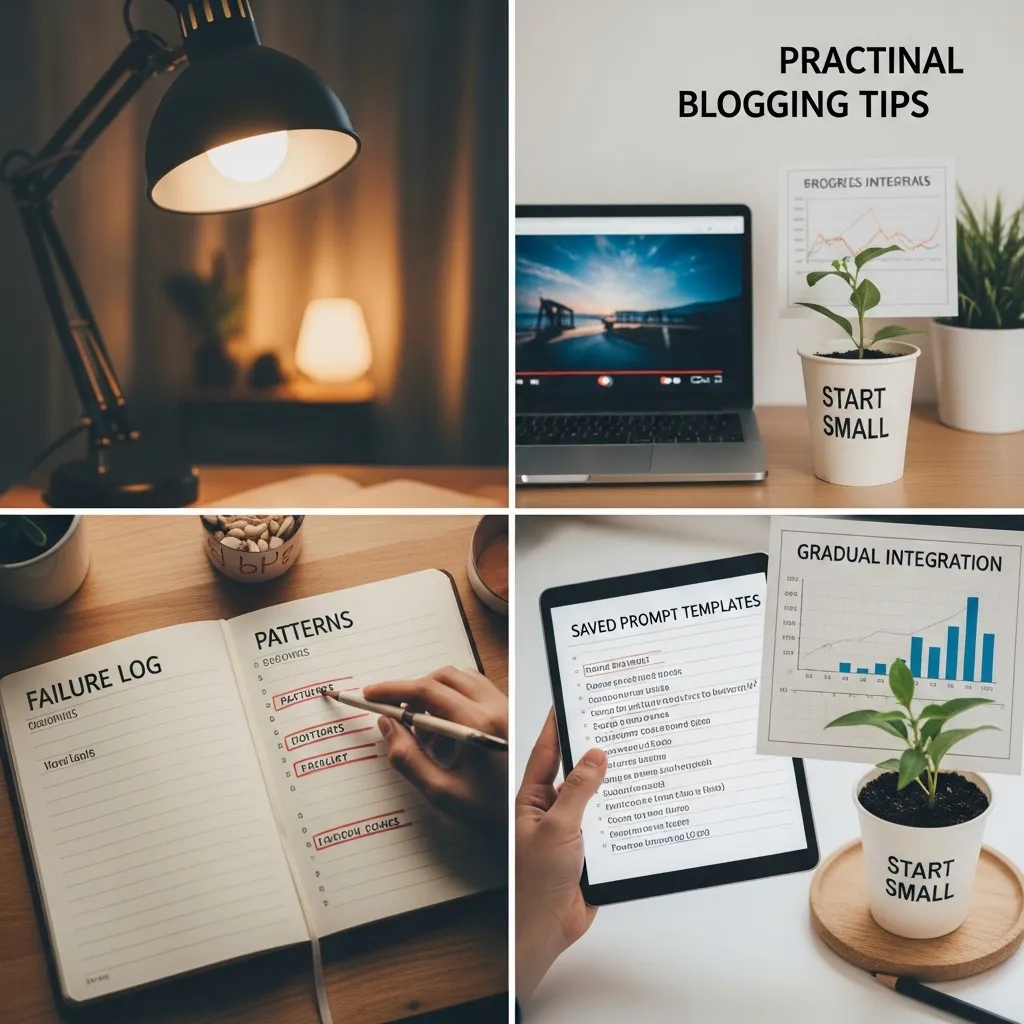
Start Small: Don’t overhaul your entire process at once. I began by using AI only for headline ideas. Once comfortable, I added outlining. Then light drafting. Gradual integration is less overwhelming.
Create Prompt Templates: I have saved prompts for common tasks, tweaked over time. This is way more efficient than starting from scratch each time.
Develop a Personal Style Guide: I created a document describing my voice, common phrases, topics to avoid, and perspective. I reference this when working with AI to keep output aligned with my brand.
Batch AI Tasks: I’ll do all my headline generation for the month at once, or all my social media repurposing in one session. Context switching between writing and AI-prompting is inefficient.
Keep a Failure Log: When AI gives you something wrong or weird, note it. Patterns emerge. I learned that Claude is better at nuanced topics while ChatGPT handles straightforward explanation better. Your mileage may vary, but you’ll develop preferences.
Invest in Learning: The $20/month for AI tools is nothing compared to the value of actually learning to use them well. I’ve taken courses, watched tutorials, and joined communities. Time well spent.
The Bottom Line
Can AI help you blog more effectively? Absolutely, if you use it thoughtfully.
Will AI replace human bloggers? Not the good ones. The internet has enough generic content. What’s valuable is your specific expertise, experience, and perspective. AI can help you share that more efficiently, but it can’t create it for you.
I’m more productive, my content quality has improved (according to both metrics and reader feedback), and I actually enjoy the writing process more because I’m spending time on the interesting parts rather than staring at blank pages.
But I’m also more conscious of what makes content valuable, more careful about accuracy, and more intentional about adding my unique perspective.
AI is a tool. A powerful one, sometimes a frustrating one, increasingly an essential one. But still just a tool.
The question isn’t whether to use AI for blogging. In 2026, that ship has sailed. The question is how to use it in a way that makes your blog better while maintaining the authenticity and value that made people care about it in the first place.
Start experimenting, make mistakes (you will), stay ethical, keep learning, and remember that your human judgment is the most valuable part of the equation.
Frequently Asked Questions
1. Will Google penalize my blog if I use AI to help write posts?
Based on Google’s official statements and my experience with multiple blogs, no—as long as the content is actually valuable to readers. Google’s position is that they evaluate content quality, not creation method. That said, I’ve seen thin, obvious AI content fail to rank, not because it was AI-written but because it was shallow and unhelpful. My blog using AI-assisted content has grown significantly in organic traffic, but I’m publishing genuine insights with heavy human oversight. The risk isn’t AI use itself; it’s publishing low-effort content that doesn’t serve readers. If you’re using AI to help research, structure, and draft content that you then enhance with real expertise and perspective, you’re fine. If you’re auto-publishing unedited AI output on topics you don’t understand, expect problems.
2. How much should I edit AI-generated content before publishing?
There’s no magic percentage, but here’s my rule: If I can’t identify at least five substantial improvements to make, the content is either perfect (rare) or I don’t know the topic well enough to be writing about it (common). In practice, I typically rewrite or heavily edit 40-60% of any AI-generated draft. I always rewrite introductions and conclusions entirely, add specific examples AI couldn’t know, fix factual issues, adjust tone to match my voice, and add original insights. Some sections might stay mostly intact if they’re explaining straightforward concepts, but anything requiring nuance, personality, or accuracy gets human attention. I also fact-check everything important. If you’re editing less than 20-30%, you’re probably publishing generic content that won’t stand out.
3. What’s the best AI tool specifically for blogging in 2026?
Honestly, there’s no single “best” tool—it depends on your workflow and needs. For general writing assistance, I prefer Claude for long-form content because it handles context better over extended conversations, but ChatGPT is excellent for quick tasks and generating variations. For SEO-specific work, specialized tools like Surfer SEO or Clearscope integrate AI with content optimization, though they’re expensive ($200-300/month). For research with citations, Perplexity AI is fantastic. My advice: Start with ChatGPT or Claude’s free versions and learn the fundamentals before investing in specialized tools. Most bloggers don’t need expensive specialized software—they need to get good at working with general AI assistants. The tool matters far less than how you use it.
4. Should I disclose to readers that I use AI in my blogging process?
This is still evolving, and different bloggers make different choices. My approach: I don’t add disclaimers to individual posts (“portions written with AI assistance”) because I also don’t disclaim using Grammarly, research tools, or an editor. However, I am transparent about my general process in my About page and methodology sections. If AI played an unusual role in a specific post—say, analyzing a dataset or helping with a complex topic outside my expertise—I’ll mention it in context. The key question is: Are you being honest about the value you’re providing? If you’re presenting AI-generated content as your own expert insights without actually having expertise, that’s deceptive regardless of disclosure. If you’re using AI as one tool among many to share your genuine knowledge more effectively, I think light transparency (general process disclosure, not post-by-post disclaimers) is sufficient. Watch your niche’s norms and err toward more disclosure if unsure.
5. Can I build a successful blog in 2026 using mostly AI-generated content?
Can you? Technically yes. Should you? I strongly advise against it. The internet is flooded with mediocre AI content, and readers are increasingly good at spotting it. What makes blogs successful is unique perspective, specific expertise, personality, and genuine helpfulness—things AI can assist with but not create from nothing. I’ve seen new bloggers try to shortcut by publishing lightly-edited AI content on topics they barely understand. They typically get low engagement, poor rankings, and no loyal audience. The successful new blogs I’ve observed use AI to amplify their existing expertise and unique angle, not replace it. If you have real knowledge or experience in a subject, AI can help you publish better and faster. If you’re just trying to create content volume without bringing anything unique, you’re competing with millions of other AI-content farms and probably losing. Focus on what makes your perspective valuable, then use AI to help communicate it more effectively.