How to Use AI for Business: Real Implementation Insights from Someone Who’s Been There
How to Use AI for Business: Real Implementation Insights from Someone Who’s Been There
I’ll never forget the executive meeting in early 2024 where our CFO asked, “So how much are we saving with all this AI stuff?” I had to admit that after three months of implementation, we’d actually spent more money than we’d saved. The silence was uncomfortable. But here’s the thing—eighteen months later, that same AI infrastructure has reduced our customer service costs by 34%, improved our sales team’s close rate by 22%, and saved our operations team about 15 hours per week on routine tasks.
The gap between those two moments taught me everything I now know about implementing AI in business. It’s not plug-and-play magic. It’s not an instant ROI generator. But done thoughtfully, it can fundamentally improve how your business operates.
I’ve now helped implement AI solutions across three companies—a mid-sized B2B software firm, a consumer products company, and a professional services consultancy. I’ve seen spectacular successes and expensive failures. Let me share what actually works, beyond the hype and the vendor pitches.
The Reality of AI in Business (2026 Edition)
The AI business landscape has matured considerably since the ChatGPT explosion of 2023. We’re past the “let’s try AI for everything” phase and into the “where does this actually make sense” phase.
As of 2026, most businesses are using AI in at least one of these areas:
- Customer service and support
- Marketing content and campaign optimization
- Sales enablement and lead qualification
- Data analysis and reporting
- Process automation
- Product development and testing
But here’s what the case studies and vendor decks don’t tell you: implementation is harder than adoption. Getting the technology working is the easy part. Getting your team to use it effectively, integrating it with existing systems, and actually measuring impact—that’s where most businesses struggle.

Where AI Creates Real Business Value (With Actual Numbers)
Let me break down the areas where I’ve seen genuine, measurable returns, starting with the most impactful.
Customer Service: The Low-Hanging Fruit
This was our first major AI implementation, and it remains the highest-ROI application we’ve deployed.
What we did: Implemented an AI-powered customer service system that handles initial inquiries, resolves simple issues, and routes complex problems to human agents with full context.
The setup: We used a combination of a customized AI chatbot (built on OpenAI’s API), integrated with our CRM (Salesforce) and knowledge base. Total setup cost was around $45,000 including consulting fees.
Results after 12 months:
- 43% of customer inquiries fully resolved without human intervention
- Average response time dropped from 3.2 hours to 8 minutes
- Customer satisfaction scores improved from 7.8 to 8.4 (out of 10)
- Reduced customer service headcount from 12 to 9 through natural attrition (we didn’t fire anyone, just didn’t backfill as people left)
- Annual savings: approximately $180,000
The reality check: The AI still makes mistakes. We have a human review queue for edge cases, and we update the system monthly based on where it struggles. The first two months were rough—the AI would confidently give wrong answers, frustrating customers until we fine-tuned it. This isn’t set-and-forget technology.
Sales Enablement: The Unexpected Win
I was skeptical about AI in sales. Seemed like the kind of thing that would annoy our sales team and our prospects. I was half right and half wrong.
What works:
Automated lead scoring and prioritization: AI analyzes engagement signals, company data, and historical patterns to identify high-potential leads. Our sales team now spends time on leads that are actually ready to buy instead of cold outreach to anyone who downloaded a whitepaper.
Email drafting and personalization: Sales reps provide bullet points about what they want to communicate; AI generates personalized emails that the rep then edits. This was controversial initially, but it’s now widely used because it cuts down the time spent on routine follow-ups.
Call preparation: AI pulls relevant information about prospects before calls—recent company news, previous interactions, potential pain points based on industry—and creates brief prep documents.
What doesn’t work:
- Letting AI write cold outreach emails without heavy editing (they sound generic and get low response rates)
- AI-generated sales scripts (too stilted, reps hated them)
- Automated AI voice calls (we tried this in 2024; response was overwhelmingly negative)
Results: Our sales team’s efficiency metrics improved significantly. Average deal cycle decreased from 47 days to 38 days. Win rate on qualified opportunities increased from 28% to 34%. But here’s the key—these gains came from humans working better with AI assistance, not from automation replacing human work.
Marketing: Where AI Shines and Where It Falls Flat
I oversee marketing for one of the companies where we’ve implemented AI extensively, so I have detailed experience here.
Content creation: AI has become a core part of our content workflow, but not in the way you might think. We don’t use it to fully write blog posts or important pages. We use it to:
- Generate first drafts of email campaigns that marketers then personalize
- Create variations for A/B testing (headlines, CTAs, ad copy)
- Repurpose long-form content into social posts, email snippets, etc.
- Draft routine content like product descriptions or help documentation
One person on our marketing team now does the content repurposing work that used to require two people. That’s a real efficiency gain.
Ad campaign optimization: This is where AI delivers serious value. We use AI-powered tools (primarily Google’s and Meta’s built-in AI features, plus some specialized platforms) that:
- Optimize ad spend across channels in real-time
- Test creative variations automatically
- Predict which audiences will respond to which messages
- Adjust bidding strategies based on performance
Our cost per acquisition dropped 29% year-over-year after implementing AI-optimized campaigns. That’s a direct bottom-line impact.
Where marketing AI fails: Creative strategy, brand voice, and understanding cultural context. We tried having AI develop campaign concepts. The ideas were technically coherent but completely lacked the insight that makes campaigns memorable. Human strategists are still essential for anything requiring genuine creativity or cultural awareness.
Operations and Data Analysis: The Quiet Game-Changer
This doesn’t get as much attention as customer-facing AI, but it’s had huge impact on our operational efficiency.
Automated reporting and dashboards: We have AI systems that:
- Generate weekly performance reports that previously took an analyst 4-5 hours to compile
- Identify anomalies in data and flag them for human review
- Provide natural language summaries of what’s happening in the business (“Sales increased 12% this week, driven primarily by enterprise deals in the healthcare vertical, with notable growth in the midwest region”)
Our leadership team actually reads these reports because they’re concise and actionable. The old Excel-heavy reports often went ignored.
Inventory and supply chain optimization: For the consumer products company I work with, we implemented AI that:
- Predicts demand more accurately than our previous statistical models
- Optimizes inventory levels across distribution centers
- Identifies potential supply chain disruptions before they become critical
This reduced overstock situations by 31% and stockouts by 24%. In dollar terms, that’s hundreds of thousands in improved working capital efficiency.
Process automation: AI now handles routine tasks like:
- Data entry from invoices and receipts
- Initial categorization of support tickets
- Scheduling and calendar management
- Meeting transcription and summary creation
It’s not glamorous, but it frees up human time for higher-value work.
Human Resources: Promising but Tricky
This is where AI implementation requires the most caution because you’re dealing with people’s careers and livelihoods.
What we use AI for:
- Resume screening (with strong human oversight)
- Interview scheduling
- Initial candidate communication
- Employee question answering (HR policies, benefits info, etc.)
- Identifying skills gaps for training purposes
What we explicitly don’t use AI for:
- Making final hiring decisions
- Performance evaluations
- Determining promotions or compensation
- Any termination decisions
The legal and ethical issues around AI in HR are still evolving. We’ve taken a conservative approach: AI can assist and improve efficiency, but humans make all significant decisions. Several companies in our industry faced discrimination lawsuits related to AI screening tools, which reinforced our caution.
Results: Our time-to-hire decreased from 42 days to 31 days, mostly because AI handles initial screening and scheduling logistics. But we’re very careful to audit for bias and maintain human judgment throughout.
The Tools We Actually Use (2026 Landscape)
The AI tool market has consolidated somewhat since the chaos of 2023-2024. Here’s what’s in our actual tech stack:
Core AI Platforms:
ChatGPT Enterprise (OpenAI): $60/user/month. We have 25 licenses for team members who use AI regularly. It’s integrated with our internal knowledge base and offers better privacy than consumer versions.
Claude for Business (Anthropic): $40/user/month. We use this primarily for long-form document analysis and more nuanced work. Some team members prefer it to ChatGPT.
Microsoft 365 Copilot: Microsoft 365 Copilot Came with our enterprise Microsoft license. Integrated across Word, Excel, PowerPoint, Teams. Adoption has been uneven—some people use it constantly, others ignore it.
Specialized Tools:
Salesforce Einstein (included in our Salesforce subscription): AI features built into our CRM for lead scoring and sales insights.
HubSpot AI (included in our HubSpot subscription): Marketing automation and content assistance.
Intercom with AI features: Our customer service platform, roughly $2,500/month with AI capabilities.
Fireflies.ai: Meeting transcription and summarization, $10/user/month.
Jasper (we tried it, cancelled it): Content generation tool. We found general AI assistants more flexible and cost-effective.
Total AI software spend: Approximately $5,200/month across all tools for a company of 85 people. That sounds like a lot, but we calculate it saves us roughly $28,000/month in labor efficiency, so the ROI is solid.

How to Actually Implement AI in Your Business (Lessons from Mistakes)
If I could go back and redo our AI implementation, here’s what I’d do differently:
Start with a Specific Problem, Not a Technology
Our first mistake was saying “Let’s implement AI” instead of “Let’s solve our customer response time problem.”
When you start with a specific business problem, you can:
- Measure whether AI actually helps
- Compare AI solutions to non-AI alternatives
- Get stakeholder buy-in because you’re solving their pain point
- Avoid implementing technology for technology’s sake
The right approach: Identify your top 3-5 business pain points. Then evaluate whether AI is the best solution for each. Sometimes it is. Sometimes better processes or different tools work better.
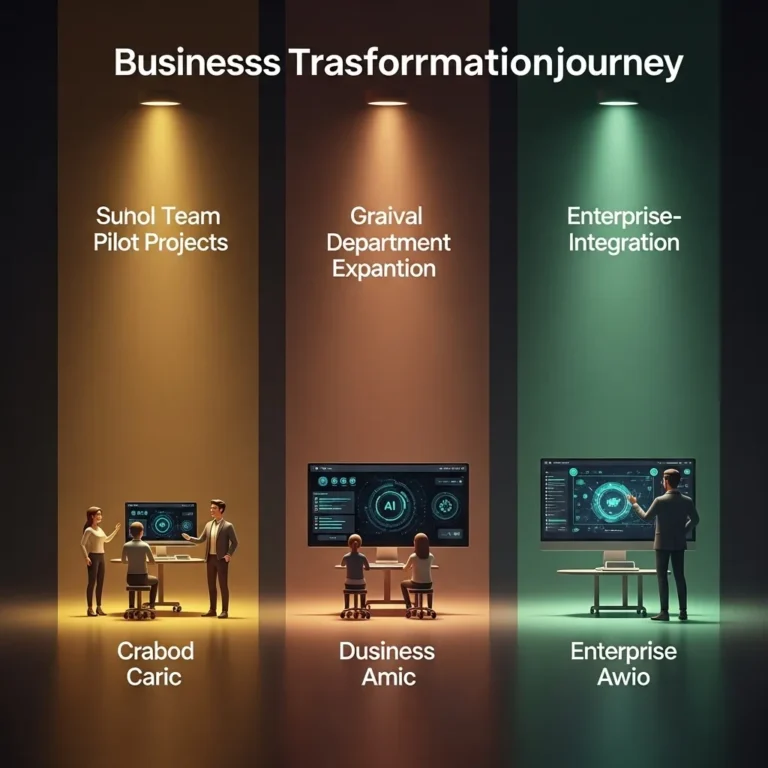
Run Small Pilots Before Broad Rollouts
We made an expensive mistake rolling out an AI writing assistant to the entire marketing team simultaneously. Adoption was low, people were frustrated, and we’d committed to an annual contract.
Better approach:
- Pilot with 2-3 enthusiastic early adopters
- Document what works and what doesn’t
- Refine the implementation
- Expand to a larger test group
- Roll out broadly only after proving value
Our successful implementations all followed this pattern. Our failures were big-bang rollouts.
Invest Heavily in Training and Change Management
This was our biggest oversight initially. We assumed that since AI tools are “intuitive,” people would just figure them out.
Wrong.
Getting value from AI requires learning:
- How to write effective prompts
- When to use AI versus when to do something manually
- How to verify and edit AI output
- How to integrate AI into existing workflows
We now run monthly “AI office hours” where people can ask questions and share use cases. We create internal guides for common tasks. We celebrate and share examples of effective AI use.
Time investment: Our team leaders spend about 2 hours per month on AI training and enablement. New employees get 3 hours of AI onboarding. It’s worth it—trained users get 3-4x more value from the tools.
Build In Human Oversight and Review Processes
Every AI system we run has defined human checkpoints.
For customer service: Random sample of 10% of AI interactions reviewed weekly
For sales emails: All AI-drafted emails reviewed by reps before sending
For content: AI drafts are always edited by humans before publishing
For data analysis: Automated reports flagged for review if anomalies detected
This catches errors, identifies areas for improvement, and builds trust that we’re not letting AI run wild.
Measure Actual Impact, Not Vanity Metrics
“We processed 10,000 customer inquiries with AI” is meaningless if you don’t know:
- How many were actually resolved correctly
- Whether customers were satisfied
- Whether it saved time/money compared to alternatives
- What problems AI couldn’t handle
For every AI implementation, we define success metrics upfront:
- What are we trying to improve?
- How will we measure it?
- What’s the baseline before AI?
- What improvement would justify the cost?
Then we actually track it. About 30% of our AI experiments fail to meet their success criteria and get discontinued.
The Hidden Costs Nobody Warns You About
Beyond the software subscriptions, AI implementation has costs that surprised us:
Integration and setup: Getting AI tools to work with your existing systems often requires developer time. Budget $10,000-50,000 depending on complexity.
Data preparation: AI is only as good as the data you give it. We spent weeks cleaning up our knowledge base, CRM data, and documentation before AI could use it effectively.
Ongoing maintenance: AI systems need regular updating, refinement, and monitoring. We have one person spending about 25% of their time on AI system management.
Failed experiments: Not everything works. We’ve spent probably $30,000 on AI tools and experiments that didn’t pan out. That’s part of the learning process.
Opportunity cost: Time spent implementing and learning AI is time not spent on other initiatives. Make sure AI is genuinely your highest priority.
Total first-year cost for our mid-sized company: approximately $180,000 including software, setup, training, and failed experiments. But annual ongoing savings are running around $340,000, so year-two ROI is very positive.

What Doesn’t Work (Save Yourself the Trouble)
Based on my experience and conversations with peers, here are AI applications that consistently underdeliver:
Fully automated content marketing: Sounds great in theory. In practice, it produces mediocre content that doesn’t rank, doesn’t engage, and doesn’t convert.
AI-generated code for production systems (without expert review): Great for learning or prototyping. Dangerous for anything critical. We had an AI-generated script cause a data integrity issue that took days to clean up.
Automated decision-making on sensitive issues: Hiring, firing, credit decisions, anything with legal implications—keep humans firmly in the loop.
Customer-facing AI without clear “this is AI” disclosure: Customers figure it out anyway, and if you haven’t been transparent, they resent it.
AI for highly specialized domain expertise: AI can assist experts but can’t replace deep expertise. We tried having AI handle technical support for complex product issues. Disaster. Now AI handles simple questions and routes complex ones to experts.
The Ethical and Legal Considerations
This is an evolving area, but here are the guidelines we follow:
Data privacy: We never feed customer data, confidential information, or personal details into public AI systems. We use enterprise versions with data protection agreements, and we have clear policies about what can and cannot be shared with AI.
Bias and fairness: We audit AI systems regularly for biased outcomes, especially in HR and customer-facing applications. When we find bias (and we have), we adjust the system or add human oversight.
Transparency: Customers know when they’re interacting with AI. Employees know when AI is being used in HR processes. We don’t hide it.
Job displacement: We’ve tried to implement AI in ways that enhance jobs rather than eliminate them. When efficiency gains reduce needed headcount, we’ve handled it through attrition rather than layoffs. This is both ethical and practical—your remaining employees watch how you handle AI-driven changes.
Intellectual property: The legal status of AI-generated content is still murky. We treat AI output as a starting point that humans refine, ensuring human creativity and judgment are clearly involved.

Industry-Specific Applications I’ve Observed
Different industries are using AI in different ways:
Professional Services (consulting, legal, accounting):
- Document review and analysis
- Research and case law searching
- Client communication drafting
- Time tracking and billing optimization
Retail and E-commerce:
- Personalized product recommendations
- Dynamic pricing
- Inventory forecasting
- Customer service chatbots
- Visual search and product discovery
Manufacturing:
- Predictive maintenance (identifying equipment likely to fail)
- Quality control and defect detection
- Supply chain optimization
- Production scheduling
Healthcare (where I have less direct experience but observe from the outside):
- Administrative task automation
- Initial symptom assessment
- Medical image analysis
- Documentation and coding
- Drug discovery research
The common thread: AI works best on tasks that are repetitive, data-heavy, or involve pattern recognition. It struggles with tasks requiring judgment, creativity, emotional intelligence, or physical manipulation.

Building an AI-Ready Company Culture
The technical implementation is only half the battle. The cultural side is equally important.
What’s worked for us:
Leadership buy-in and use: Our CEO uses AI daily and talks about it in meetings. When leaders model the behavior, adoption increases.
Permission to experiment and fail: We explicitly tell people it’s okay to try AI for tasks and have it not work. This reduces fear and increases experimentation.
Sharing successes: We have a Slack channel where people share “AI wins”—times when AI solved a problem or saved time. This spreads knowledge and builds enthusiasm.
Addressing fears directly: Some employees worried AI would eliminate their jobs. We’ve been transparent that AI changes roles but our goal is enhancement, not replacement. We’ve backed this up with actions (no AI-related layoffs, investment in training).
Creating AI champions: In each department, we have someone who’s particularly enthusiastic about AI. They help colleagues, share tips, and provide feedback on what tools would be helpful.
What hasn’t worked:
Mandating AI use: We tried requiring certain AI tools be used for specific tasks. People found workarounds. Voluntary adoption driven by demonstrated value works better.
Overhyping capabilities: Early on, I oversold what AI could do. When it underdelivered, skepticism increased. Now I’m conservative in promises and let results speak for themselves.
Looking Ahead: AI in Business 2026-2027
Based on what I’m seeing and testing now, here’s where I think business AI is heading:
Deeper integration: AI is moving from standalone tools to embedded features across all business software. Your CRM, project management, accounting software—everything will have AI built in.
Multimodal capabilities: AI that handles text, images, video, and audio in integrated workflows. We’re already testing tools that can analyze sales calls, extract action items, and automatically update CRM records.
Specialized industry models: Instead of general AI, we’re seeing models trained specifically for legal work, healthcare, financial services, etc. These tend to be more accurate for specialized tasks.
Better measurement and attribution: Tools for actually measuring AI’s business impact are improving. Right now, it’s still somewhat guesswork. Better analytics are emerging.
Regulatory frameworks: Governments are starting to regulate AI use, especially in hiring, lending, and other sensitive areas. Compliance will become a consideration.
AI agents: Moving beyond chatbots to AI that can actually take actions—booking appointments, making purchases, updating systems—with human approval. This is promising but also concerning from a control perspective.

My Honest Assessment: Is AI Worth It for Your Business?
After three years of intensive AI implementation work, here’s my take:
AI is worth it if:
- You have repetitive, data-heavy tasks that consume significant time
- You’re willing to invest in proper implementation, not just buy tools
- You have leadership support and resources for change management
- You can clearly define and measure success
- Your team is open to new ways of working
AI probably isn’t worth it yet if:
- Your business is very small (under 10 people) and everyone’s wearing multiple hats
- You’re in financial distress and need immediate returns
- Your industry has unclear AI regulations and high legal risk
- You haven’t solved more basic operational problems
- You’re looking for a magic solution rather than a tool that requires work
For our mid-sized company (85 people), AI implementation has been absolutely worth it. We’re more efficient, our customers get faster service, our team spends less time on grunt work, and our bottom line has improved.
But it required investment, patience, experimentation, and ongoing attention. It’s not passive income. It’s not plug-and-play. It’s a genuine operational shift that, when done thoughtfully, creates sustainable competitive advantages.
Getting Started: A Practical Roadmap
If you’re convinced AI makes sense for your business, here’s how I’d recommend starting:
Month 1: Assessment and Education
- Identify your top business problems and pain points
- Evaluate which might benefit from AI
- Have key team members experiment with ChatGPT or Claude for work tasks
- Research AI tools relevant to your industry
Month 2: Small Pilot
- Choose one specific, measurable problem to address
- Select an appropriate AI tool (start with something low-risk)
- Implement with a small group of early adopters
- Document results carefully
Month 3: Evaluation and Iteration
- Measure results against your success criteria
- Gather feedback from pilot users
- Refine the implementation
- Decide whether to expand, adjust, or abandon
Months 4-6: Gradual Expansion
- If the pilot succeeded, expand to broader team
- Begin exploring a second use case
- Invest in training and enablement
- Build feedback loops
Months 7-12: Optimization and Scaling
- Optimize successful implementations
- Test additional use cases
- Build AI capabilities into standard workflows
- Measure overall business impact
This is roughly the path we followed, and it prevented costly mistakes while building momentum.

The Bottom Line
AI in business isn’t hype, and it isn’t magic. It’s a genuinely useful set of technologies that, implemented thoughtfully, can improve efficiency, reduce costs, and create better customer experiences.
But it requires work. It requires investment. It requires patience. It requires learning.
The businesses that will win with AI aren’t necessarily those with the biggest budgets or the fanciest tools. They’re the ones that:
- Start with real problems, not shiny technology
- Implement thoughtfully with proper change management
- Measure actual impact honestly
- Iterate based on results
- Keep humans in the loop on important decisions
- Stay ethically grounded
Three years into this journey, I’m more bullish on business AI than ever, but also more realistic about what it takes to succeed. The technology keeps improving. The tools keep getting better. The use cases keep expanding.
If you’re not experimenting with AI for your business in 2026, you’re probably falling behind. But if you’re implementing AI without strategy, measurement, and proper oversight, you’re wasting money on expensive experiments.
Start small. Learn fast. Scale what works. Stay skeptical of vendor promises. Keep humans at the center.
That’s what’s worked for us, and that’s what I see working for the successful AI-adopting businesses around me.
Frequently Asked Questions
1. How much should a small-to-medium business budget for AI implementation?
This varies wildly based on what you’re trying to do, but here’s realistic guidance from my experience. For a company of 20-50 people, budget $500-1,500/month for software subscriptions (AI tools typically charge per user). Add $5,000-15,000 for initial setup and integration if you need custom work. Then factor in 10-20 hours per month of internal time for training, management, and optimization. For our 85-person company, we spend about $5,200/month on AI tools plus probably 40 hours/month of internal time. But we also save roughly $28,000/month in efficiency gains, so the ROI is strong. Start small—you can experiment meaningfully with just ChatGPT or Claude subscriptions ($20-40/user/month) before committing to specialized tools. Don’t let vendors convince you that you need expensive enterprise solutions right away.
2. What’s the realistic timeframe to see ROI from business AI implementation?
Be patient—this isn’t an overnight transformation. For simple applications like meeting transcription or basic chatbots, you might see positive ROI within 1-2 months. For more complex implementations like sales enablement or customer service automation, expect 4-6 months before you’re truly seeing returns. Our first three months were actually net negative as we paid for tools and spent time learning rather than being productive. Real, sustainable ROI typically starts appearing around month 6-8 once you’ve figured out what works, trained your team, and optimized your workflows. By month 12, we were seeing strong positive returns. Anyone promising instant ROI is overselling. The businesses I’ve seen succeed are those that commit to at least a 6-12 month implementation and learning curve. Quick wins are possible, but transformational impact takes time.
3. How do I convince skeptical employees to adopt AI tools?
This was one of my biggest challenges. Don’t mandate from the top down—that creates resistance. Instead, find your early adopters (there are always 2-3 people excited about new technology) and support them in getting real wins. When other employees see their colleague finishing work faster or solving problems more easily, they get interested. Share concrete examples: “Sarah used AI to reduce her weekly reporting time from 4 hours to 45 minutes.” Provide hands-on training, not just theoretical presentations. Address fears directly—if people worry about job security, explain how AI changes their role rather than eliminating it. And be honest about limitations; when employees see you’re realistic about what AI can and can’t do, they trust you more. We’ve had success with “lunch and learn” sessions where someone demonstrates a specific AI use case with time for questions. Most importantly, make AI optional initially—when people choose to adopt because they see value, adoption is sustainable.
4. What are the biggest legal and compliance risks of using AI in business?
This is evolving rapidly, but here are the current main concerns based on my experience and legal consultations. First, data privacy: Don’t put confidential customer information, personal data, or proprietary information into consumer AI tools. Use enterprise versions with proper data protection agreements. Second, bias and discrimination, especially in HR: AI systems can perpetuate bias in hiring, promotion, or termination decisions. Several companies have faced discrimination lawsuits over AI screening tools. We maintain human decision-making on all significant HR matters. Third, intellectual property: The legal status of AI-generated content isn’t fully settled. There are questions about copyright, ownership, and whether AI output infringes on training data sources. We treat AI as an assistant, not the creator, ensuring human contribution is substantial. Fourth, industry-specific regulations: Healthcare, finance, and legal services have specific compliance requirements that AI implementations must respect. Work with your legal counsel to review AI use cases before implementation. The regulatory landscape is changing—expect more AI-specific regulations in the next 2-3 years.
5. Should I build custom AI solutions or use off-the-shelf tools?
For most small-to-medium businesses, off-the-shelf tools are the right answer. Custom AI development is expensive ($50,000-500,000+ depending on complexity) and requires ongoing maintenance. Unless you have very unique requirements or AI is a core competitive differentiator, start with existing solutions. We use almost entirely off-the-shelf tools—ChatGPT, Claude, Salesforce AI, HubSpot AI, etc.—and they handle 95% of our needs. The 5% we’ve customized involved using AI APIs to integrate with our specific systems, which cost about $20,000 in developer time but was worth it for our customer service implementation. The exception: If you’re a larger company (500+ people) with specific requirements, or if AI is central to your product offering, custom solutions might make sense. But for most businesses, the innovation is happening in commercial products, and your competitive advantage comes from implementation and use, not from building your own models. Use your development resources to integrate and customize existing AI tools rather than building from scratch.